A Family Memoir
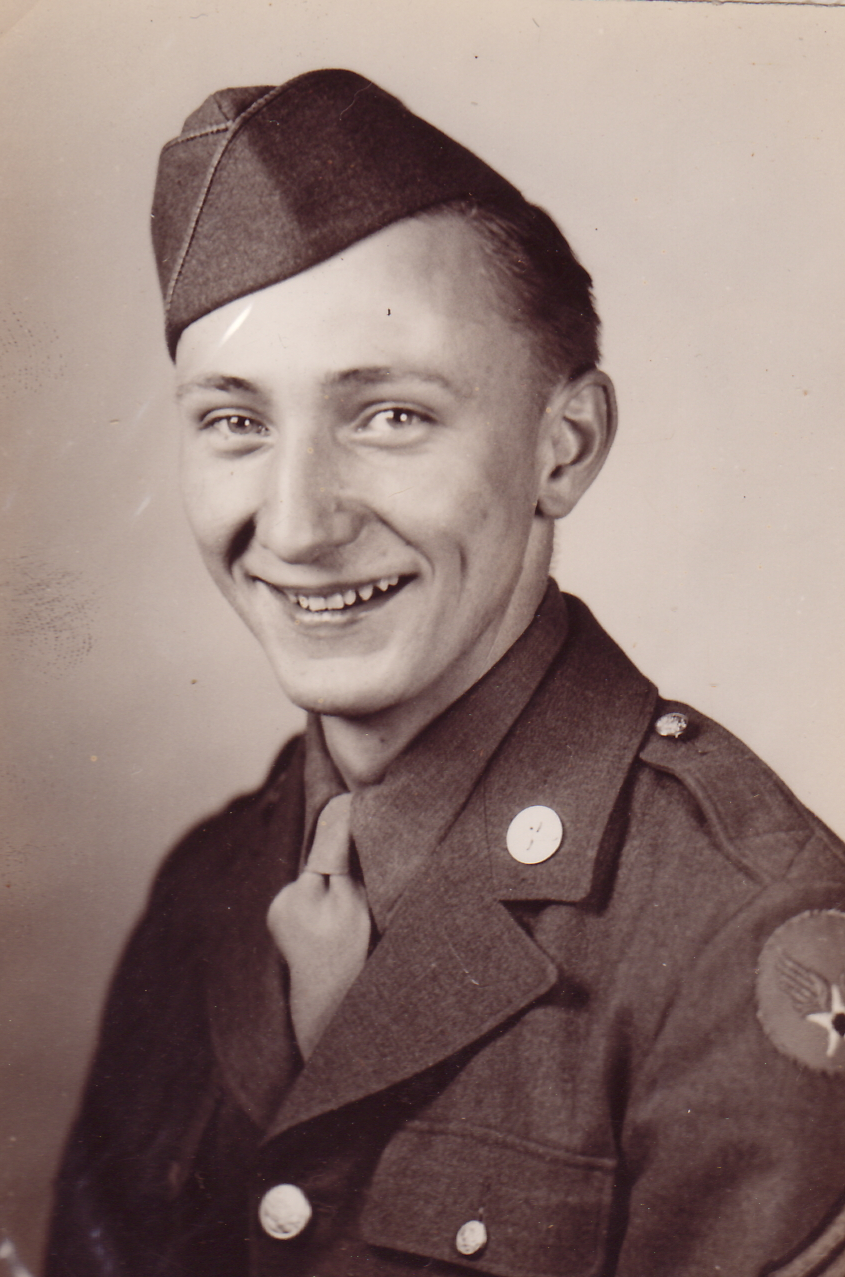
Dear Pop
The Wartime Letters of Cpl. Arthur M. Yena
783rd Bomb Squadron · 1943–1945
A Family Memoir
Dear Pop
The Wartime Letters of
Cpl. Arthur M. Yena
783rd Bomb Squadron · 15th Air Force
1943–1945
For the Yena family · West Warwick, Rhode Island
[ to be written ]
A short dedication will live here — a few lines, italic.Contents
Part One — A Farm Boy Goes to War
- Prologue: Who Arthur Was1
- 1. The Lace Mill on Quaker Lane7
- 2. The Wash-Out21
- 3. Six Words a Minute37
- 4. McCook and Connie53
- 5. A Liberty Ship to Oran73
- 6. Foggia, and the Foxholes Below93
- 7. The Demotion No One Could Explain113
- 8. A Wedding Letter to Anne131
- 9. The War Ends, Slowly153
- 10. Coming Home177
Interlude — The Outfit173
Part Two — The Letters in His Own Hand
- A Note on the Transcriptions189
- 1943 — Tucson & McCook (54 letters)193
- 1944 — Transit & Italy (132 letters)241
- 1945 — Italy & Home (114 letters)347
- Index of Recipients441
Part Three — Behind the Book
- A Note on Method461
- Scanning & Transcribing the Letters465
- The Companion Audio & the Voice Clone473
- Sources & Acknowledgments481
Prologue
Who Arthur Was
Before any of the rest of this matters — before the bombs and the cipher room and the letters home — there was a kid from Quaker Lane. Born in April 1924, in a tenement on the Polish side of a Rhode Island lace-mill town, to a father who worked the looms in West Warwick and a mother who could not read English. He had two brothers, one older sister, and a Polish surname that nobody in town ever quite spelled right.
This Prologue is where the family memoir begins — with Arthur himself, before the war. Who his parents were, how they got from a village outside Warsaw to a triple-decker on Quaker Lane, what kind of Polish was spoken at the dinner table, what the lace mill smelled like at the end of a shift, which language he and his sister Anna fought in. The shape of a young man before the United States Army Air Forces found him.
“Polish is what we are. American is what we will become. English is how we will get there.”
The Prologue establishes the Arthur the rest of the book will be writing letters home from — so that when, four hundred pages later, he closes a letter with "Love to Mom and everyone at home," the reader knows exactly who is at home, and what that means.
placeholder — Prologue to be drafted from Mom-interview, family photos, the 1973 letter from Poland, and the surrounding silencesPart One
A Farm Boy
Goes to War
"I would like to be a hero, but I would rather have my life." — Pops, from a letter, summer 1944
Chapter One
The Lace Mill on Quaker Lane
Before I knew my grandfather had crossed an ocean to fight a war, I knew there was a letter missing from our family. You don't notice an absence the way you notice a thing; you inherit it, the way you inherit a surname or a jaw.
So watch his hands first. It is 1942, and my great-grandfather — the one Pops called Pop — is at the kitchen table on Quaker Lane in West Warwick, Rhode Island, with the day's mail fanned under his fingers. He has come up from the lace mill to read it aloud, headlines crossed over into the Polish my great-grandmother can follow. He sorts by feel as much as by sight. The paper, folded once, set aside. A bill, the kind of envelope with a window in it, the kind that tells you what it wants before you open it. Then the rest of the small paper traffic of a working house, gone through twice — the way a man does when he is looking for one particular envelope and pretending he is not.
It is not there. It has not been there for years. It would have come from Warsaw, from a street my grandfather could only ever spell from memory, from an Aunt Helen and an Uncle Karl and a cousin who carried his own sister's name. The last one had come, as my grandfather would write down for an Army officer three years later, still trying to get the date right, in "a letter in 1939 or 40." After that, nothing. Not a card. Not a returned letter. Nothing you could hold.
The bill gets paid. The paper gets read aloud. And the absence gets folded back into the day, set down beside the bill and the newspaper, handled like any other piece of the mail.
That is the house my grandfather was about to leave: a table where the most important letter is the one that never comes.
Here is what I can stand behind. Across roughly three hundred surviving letters, written from a dozen postmarks on two continents over three years, the address on the envelope almost never changes. It is the one fixed point in a young man's geography that otherwise lurches every few weeks from Florida to Arizona to Utah to California to Italy. Mr. John Yena Sr., Quaker Lane, West Warwick, Rhode Island. When the letter goes to my great-grandmother instead, the only thing that changes is the first line: Mrs. Elizabeth Yena, Quaker Lane, West Warwick, Rhode Island. Same lane. Same town. Same hand.
So before this book reads a single one of those letters, it has to make Quaker Lane real — has to make it somewhere, and not just a return address typed at the top of a soldier's page. Because every letter my grandfather wrote for three years was a letter to here. To this lane, this kitchen, these people. When he was cold he thought of it, and when he was sick he thought of it, and long after he had nothing left to say he still addressed the envelope to it.
I want to tell you the shape of the building. I want to tell you it was a triple-decker tenement of the kind that lined the mill towns of the Blackstone and Pawtuxet valleys — three flats stacked above a narrow yard, one immigrant family to a floor — and that the Yenas had the third. But I can't tell you that from the letters, because no letter describes the building. The triple-decker is the picture I grew up with, and a picture is not a fact, and I have promised myself, in writing this, not to hand you a picture dressed as a fact.
What I can give you is the neighborhood the letters draw without meaning to, in the margins, in the lists of people Pops asks after. It is not the neighborhood of a single immigrant clan keeping to itself. It is a working block where the names run in every direction at once. In December 1944, from somewhere in Italy, Pops sat down to thank everyone who had sent him a Christmas package, and the list he produced reads like a roll call of the lane: he had heard, he told Pop, from "Mr. Watts, C.C. Club, Mrs. Hildebrandt's daughter Ruth, Lorraine, Neil," and a friend named Walt. The Hildebrandts. The Wattses. A German-sounding surname and an English one and a club, all in one breath, all sending one Polish-Austrian kid socks and fruitcake across the ocean. Whether the Hildebrandts lived next door, whether they were a German immigrant family at all, I don't know — the letter only names Mrs. Hildebrandt's daughter Ruth as someone who mailed him a package.
The following spring there were the Smedleys. On 6 April 1945 — his twenty-first birthday, as it happens, though he doesn't mention that to Pop — he wrote: "I received a letter from Mrs. Smedley's daughter telling me about Arthur and asked me to try and let her know a few things." The Arthur there is not my grandfather. It is another young man, another soldier from the same lane, gone overseas like him, and the Smedley family had written to my Arthur to ask if he could find their Arthur in the enormous machinery of the war and send word home. He had just missed him at a rest camp in February, he explained, and the censorship rules made it hard, but he'd try. I find that I cannot read it without hearing the whole block in it: a lane that had sent so many of its boys into the same Army that the families had taken to writing the ones who'd left to ask after the others.
That is the point of the address, then. The three hundred letters were not from a soldier in a void to a generic American family. They were to a neighborhood — to a Polish-Austrian household stacked among German and English and Irish households, all of them feeding the same mills, all of them sending their children down the same train line, all of them reading their mail at the same end of the day.
Now Pop himself. I have to build him almost entirely out of the way his son wrote to him, because the letters that came back the other way — Pop's own, the hundreds he must have written across three years — did not survive in the box. But a man is legible in how his children speak to him, and one line does most of the work.
It is in that same 6 April 1945 letter, and it is the line I have chosen to stand at the head of this chapter. Pops is twenty-one years old, sitting in a tent in Italy, and he stops the war news to praise his father's penmanship: "You're doing pretty well in writing, as I said before, and for not having gone to school in the states the spelling is very good. I've had occasion to glance through some of the letters of a few kids who have gone to school and I must say, it's a wonder they ever got as high in school as they have. I always look forward to your letters."
Read that twice. For not having gone to school in the states. In one subordinate clause my grandfather tells us most of who his father was: an immigrant who learned to write English somewhere other than an American classroom — on a mill floor, from a newspaper, by candle at a kitchen table, I don't know which, and the letter doesn't say. What the letter does say is that the son, college-track in his own mind, has read the letters of American-schooled boys his age and found them wanting beside his foreign-schooled father's. I always look forward to your letters. This is not a boy embarrassed by where he comes from. This is a boy who has gone out into the wider Army, measured it, and come back impressed by his own father.
I won't tell you Pop's first language, because the letters don't. The clearance forms my grandfather filled out later would have known it; he never wrote it down for us.
What ran underneath the whole house was the mill. West Warwick in those years was lace country — among the largest lace-manufacturing centers in America — and Pop was a mill man. The letters carry the mill as a living thing, a place with a known population. "Give my love to Ma and everybody at home," Pops signed off to his father on 2 June 1943. "Give my regards to everybody in the mill." That second sentence is the tell: there is a group of people, by 1943, who could be called "everybody in the mill," people his son knows by face and wants remembered to. Pop did not work alone at a loom for a stranger. He worked among people, and his son had grown up among them too.
And the mill grew. Two years later, in the summer of 1945, Pops opened a letter from home and was startled by what his father had pulled off. "I was surprised to hear that you were moving the mill over to Centerville," he wrote on 27 June 1945. Not working at a mill — moving one. By then Pop was running enough of an operation to relocate it to the next village over. "By gosh things are changing around so fast I'm going to have quite a time keeping up with them," his son added, in the same breath, and you can feel the boy three thousand miles away trying to hold the picture of home still while it rearranges itself without him. Exactly what Pop's relationship to that mill was — owner, lessee, the foreman of a section — the letters don't establish, and exactly when the move happened I can't fix either.
There is one more thing the war made of Pop, and it surprised me. He was not only a loom man. He was a man of the town's wartime life. "I guess Pop has his hands full with the U.S.O. and the camp here," Pops wrote his sister on 1 June 1943 — the first time in the whole corpus that Pop appears as something other than a mechanic. The USO. The man who came up from the looms to read the mail aloud was also, by mid-1943, busy enough with the local servicemen's organization that his son a continent away pictured his hands full of it. Whether he ran it or simply gave it his evenings, I won't claim.
And under all of it, the working-family register — the one old car, the borrowed truck, the hands that did the hauling. Two years into the war, in that same April 1945 letter, my grandfather and three other men were dragging a truckload of sand and cinders across a base in Italy to level a dirt floor in their tent, and the work turned him homeward without warning: "It kind of reminded me of the days we used to fill up our old model-T truck with dirt from the front yard and the driveway." A father, a few kids, an old Model-T, and a job of moving earth from one part of the yard to another — that is the family's economic altitude, written down by accident, twenty years on. He didn't romanticize it. He just recognized it. The Model-T was gone by then; the family's car was a 1940 Ford, and even that he had half lost track of: "I guess the Ford is getting old and I don't realize it... I never figured it's going on 4 years old, or is it 5?" — one Ford, going on four years old, or five; he couldn't say, three thousand miles from the driveway.
This is the arc the rest of the book leans on: an immigrant who never sat in an American schoolroom, who learned his English the hard way and wrote it better than the schooled boys, who ran looms for someone and then was running a mill across town, who gave his evenings to the USO — and who became, for three years and three hundred letters, the address. The man at the kitchen table. The one his son wrote to first.
If Pop is the man you can read in how his son wrote to him, Mom is harder, and the difficulty is itself the truth about her. Elizabeth Yena does not write back in this archive. She is reached, and she reaches, only through other hands.
The letters that go to Mom are rare and a little formal, as if her son is on his good behavior. The first one in the whole corpus — typed, not in his usual cursive — opens on 7 April 1945, the morning after his birthday: "Dear Mom. Your swell Easter Card just came the other day. The bud from the Gardenia plant and the 2 dollars came all right too. Thanks a lot for everything!" A clipped bud from a houseplant, mailed across the Atlantic; a two-dollar bill; an Easter card. That is the shape of what Mom sent — things, not words. And the register of the letter back to her is tender, careful, health-first: "I'm very glad to hear that you're up and around and feeling better." She had been unwell. He keeps his sentences gentle.
How did a letter even reach her, when the household's whole literacy in English ran through Pop? The answer arrives in the single most quietly astonishing line in the archive, the first sentence of a letter dated 27 July 1945: "Received the letter that I believe Grandma wrote for you and was very happy to hear you're feeling fine."
The letter that I believe Grandma wrote for you. Read it slowly and a whole hidden machinery of the family turns over. When Mom wanted to write to her son at war, she did not pick up a pen. Someone called Grandma picked it up for her — held the pen, found the English, put down Mom's voice in a language Mom could not herself set on paper, and signed it Mom. My grandfather knew it, or guessed it; note his own hedge, "I believe." He could tell his mother's letter from his grandmother's hand.
So this is the architecture of the family's correspondence, and the reader needs it before Part Two reads a single letter to or from "Mom." There were really four channels. Arthur wrote to Pop — direct, in English, and that was the bulk of it. Arthur wrote to Mom — rarely, carefully — and Pop read those letters aloud to her, crossing them into Polish at the kitchen table. Pop wrote back to Arthur, the most common return current. And Mom wrote back to Arthur the rarest way of all: in her own voice, in Grandma's hand, in an English she could speak through someone else but not write herself. The Polish-speaking mother of this house is not silent in these pages. She is mediated — present in every letter, and present nowhere with a pen of her own.
That she could not read or write English is something I have always understood about her, but I want to be honest that the letters never say it outright. They only ever show the workaround — Pop reading aloud, Grandma writing for her — and never the plain statement. The architecture is real; the diagnosis behind it I am taking from family memory rather than from the letters.
Of Mom's own life there are two stray facts the letters let slip, and both are second-hand. The war put her to work. "Glad to hear Ma is still doing good in the shop," Pops wrote his sister on 7 June 1943, and then: "Oh yes Harold said she runs the machines for Pop in the Evening some time." Note the sourcing — Harold said. He did not see it; a correspondent told him, and he passed it on. But the picture is concrete and it moves me: Mom, who could not read the country's language, running the looms herself in the evenings, doing Pop's work after Pop's own day was done, the two of them keeping the mill alive between them as the children left one by one.
The household my grandfather grew up in was loud with children, and the letters let you stand in the doorway of a Sunday morning and hear it.
Anna comes first, and she comes first in the only way the letters can prove: she is the one Pops wrote to more than anyone, the sister who got the letters Pop never would — the wisecracks, the cynicism, the unguarded stuff. When she sent him news of her engagement and a clipping of her young man, he wrote back the kind of thing you only write a sister you trust completely. "So your boy friend went and made a hero of himself, eh?" — and then, "I would like to see my future brother-in-law just once before you tie the knot. I bet he's the tall, dark and handsome type, and judging from the clipping he's probably on the style of Errol Flynn." That is the voice no one else got. And in the same January 1944 letter, when both of them had spent half the month still dating their mail "1943" out of habit, he produced the line that is Anna and Arthur in a single breath: "Karl called my attention to it and so did Connie. Is it Spring, love, fever, leap year, or just ordinary carelessness?"
She was the older sister, plainly — older than Arthur, and his most-written-to confidante by a wide margin. Where exactly she fell among all four children, whether she was the eldest of them, the letters don't say, and I won't borrow a birth order from anywhere they don't give it.
She was also, I should be careful to say, the home Anna. There is a second Anna in this family, far away, in Warsaw, and the chapter will get to her; the two must never be folded into one. The Anna at the kitchen table is the sister. The Anna across the ocean is the silence.
The brothers stayed home, both of them, and that is its own quiet fact. Karl is everywhere in the corpus and never, in any letter, in uniform. He caught Arthur's misdated letters in January 1944; he wrote from home in the summer of 1943 ("I got a letter from Karl"); and two summers later, when Arthur needed the family to pool its memory of the lost Warsaw relatives, Karl was right there among the people he could call on at home. The letters never place him in uniform, and they never say why he didn't go. I have my guesses and I will not write them down.
Johnny is the brother I can't pin, and the difficulty is mostly that the name is overloaded. There is brother Johnny, and there is at least one little Johnny — a child, a nephew almost certainly — and the letters slide between them. Brother Johnny appears at or near home in mid-1943, when a Mr. Soyer "saw Pa and Johnny... and said they looked fine," and still at home in the summer of 1945, listed among "you, Mom, Johnny, Karl." Whether and when and where Johnny served, I cannot tell you from these letters.
The little ones are the household's weather. "Tell little Johnny to behave himself," Arthur signed off to Anna on 9 July 1943, and in the same letter he painted the room he was missing: "a typical Yena Sunday morning with little Johnny or Kathleen coming in to ask you 'what's that?' or 'what are you doing Auntie Nana!' I can smell Mama cooking all the way from here." Auntie Nana — what the small children called Anna. There is the whole house in two sentences: a sister minding the little ones, a mother at the stove, the smells of a Sunday, and a boy a continent away who can summon all of it.
Kathleen is the one the family has never fully resolved, and I won't pretend to. She is unmistakably a child still growing — "Speaking of Little Kathleen being almost as big as you are," Pops wrote his mother in April 1945 — and she writes her own letters by 1945. So: a young child, much younger than Arthur, literate, growing toward adult height. But whether she is his sister or his niece, the letters never say, and there is a complication I have to leave standing rather than smooth away: back in January 1944 he congratulated a "Kathleen" who had just had a baby. Whether the growing child and the new mother are the same Kathleen, I don't know, and I won't make them one for the sake of a clean sentence.
The family's center of gravity was not on Quaker Lane. It was in two cities my grandfather had never seen, and one of them had gone quiet.
Mom's people were in Warsaw. I can name them only because, years into the war, my grandfather sat down and named them himself — to an Army officer, trying to remember a street he had only ever heard spoken. In July of 1945, weeks after Germany surrendered, with the rest of the world starting to come home and his own outfit stuck in Italy with nothing to do, he made a decision and wrote his father about it. "I got to thinking of the possibilities of me getting to Warsaw," he wrote on 8 July 1945. "This morning I decided to do something about it. I had an interview with the Commanding Officer... and requested that he try and do something for me."
I am only planting this here; its ending belongs to a later chapter, and the ending is not a happy one. But watch what the request reveals about the years that came before it. "He took my name, yours, and the address," Pops went on, "also Aunt Helen and Anna, and Uncle Karl and the address as near as I could remember and spell. All I could remember was something like Krochmalna Street." There they are — Aunt Helen, an Uncle Karl who is not his brother, an Anna who is not his sister. The Warsaw family. And listen to how thin the thread had worn: he could only spell the street "as near as I could remember," reaching after a name even the transcript marks as uncertain, because the boy himself was uncertain. He was assembling his own mother's family from half-memory across an ocean.
How long had it been quiet? He told the officer that too: the family "received a letter in 1939 or 40," and after that, nothing. He gave the year as a range because no one in the house could be sure anymore which it was — the last letter from Warsaw had arrived so long ago that its very date had gone soft. That is the silence the opening of this chapter put a hand on: Pop going through the mail twice, for years, looking for the envelope that stopped coming sometime in 1939 or 1940 and never came again.
And there was Pop's side. "Also with Vienna or Wien Neustadt or any other place that we have relatives," Pops added in the same letter. Pop had a brother and a sister in Vienna. The letter names no names — only "relatives" in Wien — and so I cannot name them for you. But the geography is the thing. Mom's family in Warsaw, behind the Russian lines now and silent since before America was even in the war; Pop's family in Vienna, in a city that had been folded into Germany since 1938.
My grandfather was a soldier in the American Army with relatives on both sides of the European war — a Polish family being murdered or vanishing in the east, an Austrian family living inside the very country he had been trained to defeat.
The family was already searching, and had been, through every channel it could reach. At the very bottom of that July 1945 letter, after the goodbyes, came a postscript — almost an afterthought, except that it is the opposite of an afterthought: "Did you ever find out anything from the Red Cross about the folks in Warsaw?" The Red Cross. The family had filed an inquiry through American channels and was waiting, the way you wait, on word that might never come. The boy in Italy with an Army request in the works; the parents in Rhode Island with a Red Cross inquiry in the works; everyone reaching at once for the same vanished people, from opposite ends of the earth, and nothing coming back.
This is why he never talked about it in the letters. For most American families the war was a thing that arrived. For this one it was a thing the family had been losing relatives in since 1939, two years before America was in it. And then the Army did a remarkable thing to him. When he was put forward for cryptography, he had to submit to a full background check. "I had to give a whole history as usual where you were born and Mom etc.," he wrote his father on 14 July 1943. "We had our pictures taken and our fingerprints too." The check reached all the way back to the lane — even the manager of the local A & P got a letter. So my grandfather, to be trusted with America's codes, had to write down on a federal form where his Austrian father and his Polish mother were born — the two homelands then behind enemy or occupied lines — and submit it for inspection. And he cleared.
So when the standard account of the American war reaches December 7, 1941 — the radio bulletin, the family freezing at the dinner table, the country snapping awake — I have to tell it differently for this house, because for this house the war did not begin that afternoon.
I can't put my grandfather anywhere on December 7. The letters don't place him; no one in the corpus describes that day, the radio, the table, the faces. He was seventeen, about four months short of eighteen, and that is all I can say for certain. I won't invent the scene every memoir wants here.
But I can tell you who was at the table that winter, because the rest of this chapter has already told you. A mother who had not heard from her sister in Warsaw since 1939 or 1940. A father with a brother and sister in a Vienna that had been German for three years. Anna, and Karl, and Johnny, and the little ones underfoot. For that household, Pearl Harbor did not bring the war. The war had already taken the Warsaw mail two years before; it had already swallowed Vienna. December 7 did not begin anything on Quaker Lane. It only meant that America had finally arrived at the war this family had been quietly losing people to all along.
I have a way to test that this isn't just my framing, and it comes from my grandfather himself — though not from December 1941, which is exactly the point. The closest he ever came to naming the war's cost to his own family, he set not against Pearl Harbor but against his own leaving. On 7 June 1943, in a letter to Anna, he turned reflective: "You know Anna, this War actually changes Peoples lives doesn't it? About 5 months ago we were going out having a good time and Ma was always alone, now although Ma certainly isn't having a good time, we are all alone and getting a taste of what it feels like." Count back five months from June and you land in January — his own departure, not the nation's. The war that "changes Peoples lives" he dated from the morning he left the house.
That same spring he had said it gentler, in a stray undated page from around May 1943, and there it was all about his mother. "So close to her yet even though we didn't quite realize it we were far away," he wrote. "I got a taste of being alone too." That is a boy realizing, from two thousand miles off, what he had taken for granted from across a kitchen. And so many of the lane's boys were gone with him that he could write of returning his sister an entire stack of his correspondence — "something like 56 different people who wrote me." Fifty-six. A whole community at war, writing one boy, and one boy writing back to all of them.
This is also where the family's worry about Johnny lives, though the letters carry it as worry and never as fact. As late as January 1944 my grandfather was still turning the possibility over in his head rather than reporting it: "You know I often thought about what would happen if Johnny got in the Army," he wrote Anna, and then, weighing his brother the way an older soldier weighs a younger one, "he would in all probability change either for better or worse." That is a brother imagining a brother's induction, not recording it. Whether Johnny ever did go in, and when, the letters won't tell me.
April 1942. My grandfather turned eighteen, and a clock started that he could feel and could not see the face of.
And here I have to slow down and tell you what I don't have, because the slowest year of his life is the one the archive is quietest about. There is no letter from April 1942. There is no letter from any of the months between his eighteenth birthday and the snowy Saturday in January 1943 when he finally left. The earliest letter in the whole corpus with a body to it is dated 10 February 1943 — written from Miami Beach, ten days after he was already gone. So the waiting year survives only as a shape carved out by absence: the months we have nothing from.
I will not fill that silence with invention. I can't tell you whether he finished high school, though he would have been finishing his senior year that spring. I can't tell you whether he worked the mill beside Pop while he waited. I can't tell you whether there was a girl at home — Connie, the one the family remembers, doesn't appear in any of these earliest letters at all. The letters that would have come from that year did not come, or did not survive, and the chapter has to honor that the way it honors the Warsaw silence: by leaving it standing.
What I can do is let the reader feel, across the gap, what was building toward him on the far side of it. By the next June, the shape of it was visible. "In a couple of weeks if I pass the Intelligence course starting next Monday," he wrote his father on 1 June 1943, "I'll be assigned to a Bombardment Gp. as a cryptographer or code-man." A cryptographer. The boy who had been waiting in a quiet house was going to spend the war handling coded traffic — and the machinery that put him there had its own grinding bureaucracy: that same week he had to "fill out one of those great-grandmother history forms and some other kind of F.B.I. form." The Polish-Austrian kid from Quaker Lane, reaching back through his own genealogy on a government questionnaire so the Army could decide whether to trust him with its secrets — and passed.
For the texture of the waiting itself, I have only the mood he would later give it, displaced onto the Army's own version of suspended time. "I get to one place, make friends and then get shipped to another place and it goes on like that all the time," he wrote Anna. "That's why sometimes you get sorta blue." And the loneliest line of all, the one that explains so much about why the lane mattered: "If I could be with a few fellows from back home I wouldn't care where I went, but this way you go to a place and don't know anybody and that makes it so much harder." Home was not a sentiment for him but a set of specific faces. He would have gone anywhere with them. He was being sent everywhere without them.
The year ran out, the way a year does. And on a Saturday at the end of January, the boy who had been moving from room to room in a waiting house finally walked out of it.
Here is the scene the chapter has been walking toward, and here is where I have to hold two things at once, because my grandfather himself remembered it one way and recorded it another, and the gap between them is not an error to be hidden. It is the most honest thing in the chapter.
The way he remembered it, two years on, was a train and a station in the snow. In March of 1945, from Italy, he opened a letter and found a newspaper clipping inside. "That clipping from the Sunday paper showing Union Station reminds me of that time about 2 years ago when I left for Fort Devens," he wrote his father on 1 March 1945. "Of course there wasn't as much snow as that all over, but it looks a lot like it." Union Station. Snow. When I left for Fort Devens. That is the departure as it lived in him afterward, and it is the version a memoir reaches for.
But I have the contemporaneous account — his own, written within two weeks of the morning itself — and it is not a train, and it is not Union Station. On 15 February 1943, freshly arrived in Florida, he sat down to tell the whole family exactly what had happened, in order: "As you know I left Providence on a bus at about 9:30 A.M. Saturday January 30. At 12:30 we were in Fort Devens. It was very cold and about 2 feet deep snow."
A bus. At half past nine in the morning. On Saturday, January 30, 1943. Not a train, and not from Union Station — those came after. He spent four days at Fort Devens, drew his uniform and his shots, lucked out of kitchen duty, and saw two movies at ten cents apiece. And only then, on the fourth day, came the train: "We finally left 5:00 P.M. Wednesday, February 3, 1943." The train was the one south — to Miami, not from Providence — its route running down through New York and New Jersey, past the monuments of Washington, on into Virginia and Georgia and Florida. The Union Station he remembered in 1945 was almost certainly a station on that southbound line, not a platform in Providence at all. Two years had quietly fused the snowy Saturday bus and the famous-looking station into one image of leaving.
So which is true? Both are. The documented truth is the bus — 9:30 in the morning, two feet of snow, Saturday the thirtieth of January. The remembered truth is the train and the station in the snow, the way a man carries his own leaving in him after enough time has passed. I am not going to flatten one into the other. The bus is what happened; the station is how it felt, looking back; and the distance between them is just what memory does to the day a boy leaves home.
He did not leave alone. "I came with a friend of mine," he wrote in that February letter, naming a young man from West Warwick — Arthur Swedberg, a surname his own cursive renders so uncertainly that only later letters resolve the spelling — "and also we had a history professor from Harvard staying with us." Picture that: a nineteen-year-old mill-town kid and a Harvard professor sharing a Pullman berth south, a porter making up the beds, the two of them eating and sleeping and playing cards and taking turns on guard duty until the train set them down in Miami Beach. And he was not the only one from home, either: "Four of the fellows that left Providence with me are still with me right in the same hotel." The lane went with him as far as the lane could go.
Who stood on the snowy ground to see him off that Saturday morning, I don't know. No letter names anyone at the departure. I won't put Pop in his mill coat on a platform, or Mom weeping in Polish, or Anna waving, however much the scene wants them there. The letters give me the bus and the snow and the hour. They do not give me the faces, and so I will not.
He left into not-knowing. He did not even know yet what the Army would make of him. "As far as I know now, I'm in the Air Corps," he told the family on the fifteenth. "As to what I'm going to do, I don't know yet." A boy on a bus in the snow, bound for a war his family had already been losing people to for years, headed toward a job he couldn't yet name, leaving behind a kitchen table where the most important letter still hadn't come.
And here is where I will leave him — not with the bus pulling out, but with what he saw, much later, when he tried to make sense of the whole strange shape of his family's war. That summer, already on the West Coast, swept up in the machinery that would carry him to Italy, he wrote his sister a letter that turned, near the end, into the closest thing to a thesis my grandfather ever set down. Anna was doing defense work; he was in the Army Air Corps; the brothers and the boys of the lane were scattering into every service there was. He laid it out for her on 22 July 1943, and then he delivered the line that closes this chapter — wry, and proud, and entirely his:
"Did you ever stop to think? You're working for the Naval Air Corps in a way and I'm in the Army Air Corps. I always said our family would be air-minded."
The boy on the bus had become a soldier writing home. The kitchen table on Quaker Lane was still there, the address still fixed, the missing letter still missing. But the family was in the air now, all of it, scattered across services and continents — and he was the one writing it down. I always said our family would be air-minded. He was nineteen, three thousand miles from the lane, and he had just told his sister the truest thing anyone would say about the Yenas at war. This book is the rest of it.
full prose draft 1 — 2026-06-08 · every Pops quotation verified verbatim · the dashed notes mark the ~30 facts the Mom interview still has to settleChapter Two
The Wash-Out
A week and a half earlier he had been standing in the Providence cold, waiting for the induction bus. Now he had a sunburn.
That inversion is the first thing to know about where the Army sent Arthur Yena in February of 1943. It took a kid from a snowbound Rhode Island mill town and set him down on a beach — and not just any beach. The Army had requisitioned the resort hotels of Miami Beach wholesale, turned the Art Deco strip into Basic Training Center No. 9, and filled the rooms with privates. Arthur drew a room with three other fellows: a bathtub, a shower, "and everything," he reported home, a little awed. Out the back, ten yards of sand and then the Atlantic.
He wrote about it the way you'd expect an eighteen-year-old to write about the strangest thing that had ever happened to him — which is to say, mostly about the weather and the food. "Out here its always warm," he told his mother on the tenth of February. "I got a sunburn already from being outside all the time." There was a fruit stand across the street from the hotel; for a dime you could get a tall glass of orange juice that took three or four oranges to fill, squeezed in front of you so you knew it was fresh. To a kid from a town where an orange was a thing you found in the toe of a Christmas stocking, this was nearly scandalous abundance.
The letter he wrote that night — Wednesday the tenth, "its getting on 8:30 P.M." — is the earliest of his letters that survives with its body intact. There had been one before it, mailed free of postage four days earlier because he couldn't find an airmail stamp; only its envelope came down to us, empty. So the voice that carries the rest of this book begins here, on a hotel bed in Miami Beach, already doing the thing it would do for two and a half years: making a joke out of the size of his own dislocation. "I've been in the Army about a week and a half now," he wrote, "and it seems about a year and a half."
The strangeness had an edge to it that he half-noticed and half didn't. You could always see a ship out on the water, he mentioned, far out. What he did not mention — what a boy fresh from West Warwick had no particular reason to know — was that those waters were a killing ground. German U-boats had spent 1942 sinking tankers within sight of the Florida coast, silhouetting them against the glow of the resort towns, and the Army's answer was darkness. "We also have a blackout," Arthur wrote, "and I do mean a blackout. You can't see a thing after 8:00 P.M." The most glamorous coastline in America had been switched off against the war, and the boy describing the dark didn't know he was describing a front line.
The days themselves were less romantic. Up at quarter to five, roll call at five, then chow, then inspection — beds made, shoes shined, belt buckles bright — and then drill, calisthenics, drill again, six or eight miles to the parade grounds in the heat. There were compensations, and he catalogued them with real wonder. The post exchange at Miami Beach was, he informed Anna, "the biggest in the world," which was nearly true. And the place was thick with celebrities in uniform: "Last night I saw Bruce Cabot, the movie actor, in the P.X.," he wrote. "He is studying to be an officer." A mill kid and a movie star, buying toothpaste in the same building. The whole thing must have felt like a furlough with push-ups.
But the buoyancy had a floor under it, and the floor was homesickness. He was good at hiding it and not quite good enough. "This life is all right for a fellow who hasn't any home," he admitted to Anna, "but to a fellow that has it's too much restriction." The cheer in these pages is partly a performance, mounted for an audience of one anxious mother three thousand miles north. He worried about her constantly and managed her from a distance, leaning on his brother and sister to keep her steady. Take it easy "on her," he told Johnny that same week; Kathleen had written that Ma was "under a great strain."
He cut a record of his own voice at the Pepsi-Cola Servicemen's Center and mailed the disc home — his actual voice, going up Quaker Lane on a ten-cent whim. "I sent home a record of my voice," he told his father — Pop, to whom he wrote care of the Nottingham Lace Works over in Coventry, where his father worked the looms. "You can probably get a victrola somewhere," he suggested to Johnny, helpfully. Whether the disc still exists, no one yet knows.
By the third week his mother had already hung the service star in the front window — the small banner that told the street a son was off at the war. He was tickled to hear it. "When I get back," he promised her, "I frame it." He had been a soldier for less than a month, and he had not yet been anything in particular.
That was about to be decided.
Almost the first thing the Army does with a man is decide what kind of man he will be. For Arthur, that decision was supposed to happen at a desk: the Air Corps classification battery, a day of aptitude tests and a clerk with a typewriter assigning a future. But Arthur did not wait for the desk to tell him. By his second week he had already picked out the life he wanted, and he had begun, very quietly, to steer himself toward it.
He wanted to fly.
He laid it out for Anna on the twelfth of February — the same productive Friday he wrote three letters home — in the unhurried tone of a boy reporting a plan he considers settled. "I'm going to take up Aircraft Armorer or Aircraft Mechanic in some school after I finish my basic training here in about 15 days or so," he told her. "Then I think I might get to be what 'Hoppy' was, an aerial gunner." Armorer school was the doorway; the gun turret was the room beyond it. To his father, the same day, he was a touch more technical, repeating what some sergeant had evidently told him: armorer was "a preparatory course for Aircraft Gunnery." The path had a logic to it, and an idol at the end of it. Hoppy — a hometown fellow, a name the family knew, said to have made it as a gunner before him — was the proof that a kid from Quaker Lane could end up firing a fifty-caliber gun out the side of a bomber at twenty thousand feet. Who Hoppy actually was, the letters never quite say.
What matters is that Arthur had a model, and the model was airborne.
Here is the thing the boy could not see and the reader cannot help seeing. The gunner's seat was the one job in the whole Air Corps his body was going to refuse him. Six weeks from this letter, a flight surgeon would put a chart on a wall and read a number off Arthur's eyes — 20/30 — and that number would close the turret door for good. He did not know it. He was eighteen, sunburned, and certain, and he was writing toward a future that had already been cancelled in the only ledger that counted, the one kept by his own optic nerve.
The second thing worth noticing in that first letter is a single sentence tucked behind the ambition, easy to read past: "That's not positively sure so don't say anything to Ma she would only worry anyway." Don't tell Ma. Long before the Army would ever swear him to silence — before there was a cipher to keep or an oath to sign — Arthur was already sorting his news by who could bear to hear it. Anna got the truth: the gunner plan, the dream, the risk. Ma got the weather. The gun turret was simply the first secret.
He half-defended the secrecy by half-doubting the dream. Ten days later, on the twenty-second, when Anna apparently wrote back worried anyway, he walked it briskly back: "As for me being a gunner, don't worry, they put you where they want you and I might pick up something else." A boy reassuring his sister — and, in retrospect, the truest sentence in the chapter. They put you where they want you. Arthur tossed it off as a throwaway. The Army would indeed put him exactly where it wanted him, which turned out to be nowhere near a gun.
And in the meantime he was a soldier doing soldierly things, accumulating the small evidence of fitness. Out on the firing range in early March he put sixteen of twenty-five rounds into the bullseye — "a little about the average," he judged, neither bragging nor apologizing. He turned down a standing offer to stay on at Miami Beach as a drill instructor, twice, because it was too far from home and because the instructors all went hoarse from yelling. He reassured Pop, unprompted, that the old worries didn't apply down here: "The kidneys and back never bother me." He was passing everything they put in front of him, and he had started to find it funny. "I've had so many physicals since I came in the Army," he wrote Anna in mid-March, "that I'm beginning to think I'm superman that way I pass them all."
Superman. He passed them all — the kidneys, the back, the lungs, the cough that cleared by late February — because the Army had not yet pointed an instrument at the one part of him that would fail. He could not have known which test was coming. He only knew the streak, and the streak made him cocky in the gentle, self-mocking way that was his whole register.
The streak turned nineteen in the middle of it. Arthur was born the eleventh of March, 1924, in Warsaw — and on or about that birthday, down at the Pepsi-Cola center, he stepped up to the microphone a second time and cut another disc of his own voice to mail up Quaker Lane. "I made another one for 45¢ right on my birthday," he told Anna, "but I don't think it's as good as the first one. I couldn't think of what to say." A nineteen-year-old in a recording booth, tongue-tied, certain his first take was better — and somewhere, maybe, that disc still survives in an attic, a boy's actual voice waiting on a birthday. He had stopped being eighteen. He had not yet stopped being sure.
He was a soldier with a streak and a dream, and for the first half of spring the Army did nothing to contradict either one. The Army had decided what kind of man he would be. It just hadn't told him yet that it was about to change its mind.
Then the desk finally spoke. Acting on something Anna had asked him — a logistics tangle involving the family doctor, of all things — Arthur walked down to the classification department in late March and read his own file aloud, in effect, back to his sister: "I found out I was classified as a Qualified Aerial Gunner scheduled to go to school as Aircraft Armorer or Aircraft Mechanic at any time." There it was, in the Army's own hand. Qualified Aerial Gunner. The dream, ratified and typed. The clerk thought he'd ship out with the next group, and soon. On paper, the boy had gotten exactly what he wanted.
He did two characteristic things with the news. First, he hid it: "In any case don't tell Ma I'm classified as an aerial gunner because you know her she would only worry for nothing." And then — having just been ratified, in the very same breath — he named the thing that would undo him, and named it correctly. "Besides before I go to Gunnery school I think," he wrote, the doubt cutting in, "[or rather I'm sure] I'll have to take another physical examination which I may not pass." He thought it was a formality. The records show it was the gate. He had written the wash-out in his own hand, six weeks early, and then changed the subject — to the insurance policy he'd just signed, the maximum one, ten thousand dollars of it, with a flourish that breaks the heart a little the more you look at it: "I took out a $10,000 one which only sets me back $6.50 a month I think. I'm hot stuff eh? Nothing but the best for me yes sir!"
A boy on a hotel bed, classified to fly, joking about the price of his own death benefit, telling his sister not to frighten their mother. That was the high-water mark of the dream, and he had no idea it was already cresting.
All of it — the classification, the gunner's slot, the insurance — presumed he had finished basic training, and he had: he had passed the Colonel's inspection on the nineteenth of March, eight days past his nineteenth birthday, the graduating review with beds and buckles and shoes all bright, and reported the milestone home with a shrug already built into it. "I passed inspection by the Colonel and officially I'm through with basic training and am elegible for school," he told Anna. "That's just officially. Actually it don't mean a thing I'm still doing advanced training which is the same thing under a different name." He had already learned to read the Army's vocabulary for what it was — and he kept waiting to be told he was finished while the Army kept not quite telling him. Some fellows in his outfit had shipped after twelve days of basic. He had been in Miami going on two months, watching the alphabet empty out around him, men he'd just learned the names of gone by morning, and still nobody could tell him where he was going or when.
There is a line in that same letter that no fiction writer would dare invent. "After this war," he wrote to his sister, "you and I will have to write a book based on what we are learning now eh what?" He could not have known he was addressing his own great-grandson across eighty years. He only meant it the way a kid means it — that something large was happening to him, large enough to be worth keeping. He was right about that part.
When the orders finally came they came the way he'd predicted to the day. He'd told Anna the Army's timing never failed: send your summer uniform out to be pressed, ask your sister to mail the camera, mark April thirteenth on the calendar for your first full pay, and that's the morning they hand you a shipment notice. Which is precisely what happened. There was one thing he couldn't say in the letter that told her, and the way he couldn't say it is worth pausing on, because it is the first time in two and a half years of letters that the secret-keeper shows his face. "First of all I want to tell you I'm on shipment, but just when I leave I don't know," he wrote on the first of April. "I wouldn't tell anybody else about it though except the family because I'm not supposed to tell. After all in a way my life depends on it." He was a private with washed-out eyes he didn't know about yet, headed for a gunnery school he couldn't name, and he was already partitioning the world into who could be told and who couldn't — already weighing the cost of a single careless word. The man who would be sworn to silence in a cipher room was rehearsing the silence months before anyone handed him a code.
Friday, the second of April, at two o'clock they were told to pack. Supper at half past four, a bus out of Miami Beach at six, and by nine they were aboard a northbound train and he was asleep in a Pullman berth before he could see much of anything. He woke up in Jacksonville. And then began the strangest, happiest week the Army would ever give him.
He narrated it home in real time, on postcards scrawled against the sway of a moving train. "Well I'm finally on our way," he wrote from somewhere short of New Orleans. "Where to I don't know." They had crossed Georgia, Alabama, Mississippi, and they were rolling southwest on, of all things, "a Pullman with dining car and all. Pretty class eh what?" A mill kid from a town where the orange came in the Christmas stocking was being moved across the South in a sleeper car, eating breakfast off white linen in a diner on rails. He kept losing track of the direction and reading omens into it — when the train ran north toward Montgomery he was sure they were bound for Illinois, or back to Miami, the geography wheeling under him faster than a New Englander's sense of the map could follow.
New Orleans was where it tipped over into something like joy. The shipment was under an officer he could only describe as "a pretty nice guy" — a lieutenant who walked his men to Sunday services at an Episcopal church, then led them out on a walking tour of the French Quarter in the April afternoon. There was the muddy Mississippi, the oldest church in the city, a hundred and forty-eight years old, an old museum, iced tea and cake laid out for the soldiers by some local organization, ping-pong, an easy hour with nowhere to be. They ate at a cafeteria where he could have anything he wanted, and he wrote the menu down the way he always wrote food down — pork chops and lima beans, spinach, cole slaw, butter rolls, iced tea, pie. Somewhere in the middle of that Sunday he set down the sentence that names this whole stretch of his life. "This is when you get to like the Army."
Then west again, all night through Louisiana into Texas, and on Monday morning, breakfast in the dining car once more before they hit Houston. The USO there stopped him cold — lounges, reading and writing rooms, free stationery, showers, a swimming pool, ping-pong, a dance hall. "Some difference from Miami Beach," he wrote, and then put his finger on the real difference, the one underneath the swimming pool. Miami had been beautiful, "but they treat you like your a man here now." That was the thing. Somewhere between the induction bus and the Houston USO, the boy had been handed the freight of being a man, and he could feel the weight of it as a kind of gift.
The image that closes the week is the one to hold. By the time he reached Houston they had marched through New Orleans and Montgomery and now Texas — and everywhere they marched, the same thing happened. "All the people gather around to watch," he told Anna, "while we go strutting down sing the air corps songs." Picture it: a column of green privates swinging down a Southern main street, singing into the spring air about the wild blue yonder, and the townspeople drifting out to the curb to watch them go. "We've been on this train close 50 hours," he scrawled from the Houston station, the country still widening beneath him. "I'm still wondering where I wind up. I think we will soon be there though."
He thought he'd soon be there. He had no idea where there was. The train pointed on through Texas, toward New Mexico, toward Arizona — toward a flat valley in the Mojave with mountains all around it and an eye chart waiting at the end of the line.
The train let them out at six in the evening on Wednesday, the seventh of April, at a big field in the middle of nowhere. Arthur looked around at where the Army had brought him and reached, as he always did, for a joke. "Well I'm finally here in Kingman, Arizona," he wrote Anna the next day, "a lonely desolate, flat vally with mountains all around." And then the line that titles this chapter of his life, the verdict of a Rhode Island mill kid set down in the Mojave: "What a place 'Gods Country' and an airport."
Everything that had made the journey down feel like a furlough was gone here. The USO clubs with their iced tea and their dance floors, the cafeterias where you could have anything you wanted, the movie houses and the showers and the singing in the streets of New Orleans — all of that belonged to the road, and the road had ended. Kingman was a gunnery school stamped onto bare desert, a flat valley ringed by mountains with the town a few miles off and not much in it. The course would run six weeks. They could not leave camp during that time, and as Arthur pointed out with a kind of grim cheer, it would not have done much good if they could: "there isn't a place in quite a few miles and then there are a couple of homes with mostly Indians in them and may be a General store." He found the one good thing he could and held it up. "Oh well the air is nice here," he wrote, "and maybe I'll save some money when I get paid." There was nowhere to spend it.
The privation was real and oddly specific. This was the most lavishly supplied nation on earth in the spring of 1943, pouring matériel across two oceans, and it had built a school in a place that could not keep soap on a shelf. "this place hasn't got anything," he told the family a couple of weeks in, "no soap, matches, or Easter Cards and half the time they don't even have any writing paper." Miami had been the biggest post exchange in the world; the Kingman post exchange could not sell him a thing. He was confined, understocked, three thousand miles from Quaker Lane and a long way even from the General store — and he was about to lose the one thing he had been sent here to win.
He did not know that yet, on the eighth, and neither did the Army. First would come the physical. "They say its pretty stiff too," he wrote, hedging, careful, "so I won't say anything about Gunnery until after that." Read that line now, knowing what comes, and you can feel him standing at the edge of it — refusing to name the future out loud, the way you don't say a thing for fear of jinxing it. He had heard the rumors of what they did to a man who failed: this was a new field, the old hands told him, and they would most likely keep a wash-out on as a "permanent party man." That was the fear he put on paper. "I hate like heck to stay here all the time." Not the failure itself — the trap of it, frozen forever in the flat barren valley.
And the world, indifferent, threw a party next door. "I saw Bob Hope, Frances Langford, Jerry Colonna, and Virginia Bruce at the camp," he mentioned, "when he broadcasted from here last week." The Pepsodent Show troupe on a plank stage in the desert, the wisecracks rolling out over the radio to the whole country, a crowd of laughing trainees — the gaiety of the age dropped down whole into the Mojave for one hot evening. In that same envelope he tucked the proof of an earlier, sunnier self: "At last I got those 4 pictures I had taken of me in Miami. I'm sending them down in this letter." The boy in the studio portraits had not yet failed the physical.
Then the physical was stiff, and his eyes were not quite good enough. Twenty-thirty, when the Army wanted twenty-twenty: a margin so small it would not have cost him a thing in any other life. It cost him the air. He told it first to Kathleen, on the twenty-second, folded into a get-well note, almost in passing: "I was supposed to go to school here for 6 weeks and learn to be an Aerial Gunner, but I guess my eyes arn't quite good enough."
That is the whole wreck of the flying dream, in one sentence, with an I guess in the middle of it.
What he did with the disappointment tells you who he was. He did not grieve it on the page. He turned it into a kindness for his mother. Writing Anna on the twenty-sixth, he routed the news the way he routed everything that might frighten Ma — through his sister, softened, made safe. "I don't think Ma will have to worry about that gunnery any more," he began, "since I didn't make it on account of my eyes." And then, plainly: "So now you can tell Ma that I was going to be an Aerial Gunner but didn't make it on account of my eyes and that I probably won't get into anything else that requires flying. So tell her not to worry about that anymore." Failing the eye chart had a silver lining, if you held it the right way: it meant the turret guns and the open hatches and the flak were closed to him now. He handed his mother that comfort and kept the loss for himself. "Well I guess I'll be moving on now again," he added, "since I'm eliminated from Gunnery." Moving on — to what, he could not say. Limbo. The reader knows the eye chart is the luckiest thing that ever happened to him, that it is steering him, blind to it, toward a desk and a cipher machine that will outlast every gunner in his class. Arthur knew only that he had wanted to fly and now would not.
Two undated loose pages survive that read like this desert stretch — different letters, both missing their first sheet and their envelopes — though nothing on them fixes the date. One is written on his knee: "Pardon the writing but my knee isn't too steady." "Notice the flat barren country in Arizona," he wrote on the back of some snapshots, "nothing there but dust, sand and mountains." He keeps a hometown errand running through it — "When I find out about Wittig and all I'll let you know" — a boy still carrying the news of West Warwick around in his pocket across two thousand miles of sand. The other page, on different letterhead, holds the creed that kept him level: "Well if the Army isn't any good at all to me it'll make me appreciate home and the little things that ma used to do for me when I get back. I say when I get back because I want to keep apptimistic or else I'll get too homesick." When I get back. He underlined the logic of his own hope so it would not slip. There is a mystery girl, Therese, whom he thinks he saw a couple of times and promises to explain later.
And there is one flash of something harder than homesickness, a small barbed dismissal of a fellow named Howie: "I didn't say anything about Howie because I don't think he's worth wasting paper on." (The desert was, in its merciless way, obliging an old prescription — "this Arizona climate is just what Doc Witty ordered," he'd joked to Kathleen, the dry air a hometown doctor had once ordered for his chest — though it would not spare his lungs the summer that was coming.)
He had come to the desert to learn to shoot from a moving plane. He was leaving it eliminated, uncertain, writing on his knee in a place with no soap and no matches and no idea where the Army would send him next — nothing there but dust, sand and mountains. What waited for him was a word he had not heard yet.
They did not even waste the letterhead. The sheet Arthur wrote his sister on the second of May was Kingman stock — Army Air Forces Flexible Gunnery School, Kingman, Arizona printed across the top — but he was no longer at Kingman, and he was no longer in gunnery. He had carried the leftover paper out of the desert the way a man carries the souvenir of a job he didn't keep, and he was filling it in from a cot in Salt Lake City, four hundred miles north, in a holding squadron that didn't even rate its own stationery. The header lied and he let it. There was a lot, that week, that didn't match where he'd ended up.
The move had been quick and disorienting, and he narrated it for Anna the way he narrated every leg — as travelogue, because travelogue was easier than the rest. "We left Thursday about 12 noon from Kingman," he wrote, "and went West into California. We stopped at Barstow, Cal. from about 7 P.M. to 11 P.M. Then we rode through the desert and mountains of Nevada and Utah. We got here Friday night about 8 P.M." Roughly thirty-two hours, most of it dark, the troop cars grinding north and east through country he had no name for. From the Barstow layover he had mailed her a card and a book — he hoped they'd arrived; he'd run out of time to write more — one last reflex of the boy who sent his voice home on a record, still reaching back toward Quaker Lane from every depot the Army parked him in.
What he could not narrate, because no one had told him, was why. He only knew the verdict. "after being eliminated from Gunnery," he wrote — and there it was, flat and finished, the wash-out he had spent a month half-dreading now stated as plain fact, eliminated, a word with no give in it — "they tell me here there's no schools open for mechanics other than fellows graduating from Aerial Gunnery. So now they wanted to send me to a Clerical school because I got a high mark in one of the tests. Since I didn't know how to type they suggested me to go to an Intelligence School. Whatever that is. When they suggest they practically mean you do or else."
The boy who wrote those four sentences had no idea what he was setting down. He'd come in wanting to be an armorer or a mechanic — hands on engines, hands on guns. The eyes closed that door at Kingman. The eyes closed the next door too, because the only mechanic seats left went to gunnery graduates, which he would never be. So the Army did what the Army does with a kid who tests well and fits nowhere: it read his scorecard. A high mark on one of the tests, and the clerical track opened — except he couldn't type, which is the smallest, most ordinary fact in the whole letter and also the hinge of his entire war. He couldn't type. So they reached past the typing pool to the next thing a bright boy could be handed, and they suggested it. An Intelligence School.
He did not know what that was. He said so, in the most Arthur way imaginable — Whatever that is — three words tossed off like a shrug, the verbal equivalent of holding a sealed envelope up to the light and seeing nothing. The reader of this book knows. The reader knows that "Intelligence School" is the door to a locked room, to ciphers and code groups and a clearance and an oath, to night shifts over traffic that mustn't be spoken of, to the work that will carry him across an ocean and define every letter still to come. The cipher room was being assigned, in that sentence, to a nineteen-year-old who thought it was a phrase he'd never heard. And the Army wasn't asking. When they suggest they practically mean you do or else — he understood that much, the iron inside the politeness, even if he didn't understand the thing itself. A suggestion you can't decline isn't a suggestion. It's a destiny with manners.
The geography only sharpened it. Wherever this Intelligence business sent him, it would be somewhere in the Second Air Corps Area, and he'd already done the cruel arithmetic. "Then we go someplace in the 2nd Air Corps Area," he told her, "which means I can't go any farther East than Wisconsin, Tennessee, Kentucky, or Texas. So getting anywhere closer to home is out." He read the Army's map the only way a homesick boy could — as a ledger of distance from his mother's kitchen, every theater of assignment just another way of staying three thousand miles from West Warwick. Closer to home is out. He had wanted, at the very least, to drift east. The map said no.
And the small things were breaking too. "Darn it all," he wrote, "I feel lost without my watch handy. The night before I left Kingman I dropped it and the winding pin fell off again." Again — the watch had a history of failing him, and it picked the eve of his exile to do it once more. There is something almost unbearably young in it: hauled out of the desert, stripped of one future and handed another he can't name, and the loss he can actually hold in his hand is a busted winding pin. That's another thing I'll have to fix. As if that were the thing.
He found the bright sides, because he always did. He'd finally been paid — "$62.17" for two months, with April's still owed, which made him, he announced, "a rich man heh?" — money he was already earmarking for a furlough that would almost certainly never come. And the mess hall, at least, did not disappoint. "The food here is really perfect," he reported, which from Arthur was high praise and, for his mother three thousand miles off, the one line in the letter built entirely to reassure her.
Then, near the end, he gathered the whole bewildering week into a single shrug and aimed it at his sister like a joke. The gunnery dream gone, the mechanic's bench gone, "home" ruled off the map, his watch in pieces, and some unknown thing called Intelligence waiting at the far end of a track he hadn't chosen — and Arthur Yena looked at all of it and laughed. "I'll really be a Westerner won't I?"
He didn't know. He says it himself, twice over: Whatever that is. He had been handed, in place of everything he'd wanted, a word he couldn't define and an order he couldn't refuse, and he closed the letter cheerfully and signed it Love to all. The door marked Intelligence stood in front of him, unopened, and behind it was the rest of his life.
full prose draft 1 — 2026-06-16 · every Pops quotation verified verbatim · the dashed notes mark facts the Mom interview still has to settleChapter Three
Six Words a Minute
Two weeks after the Army handed him a word he couldn't define, Arthur decided he was glad to have it.
It is easy to miss, because he buried it in the middle of a letter about money and the weather. Writing to his father on the seventeenth of May — from a cot in Salt Lake City, on a sheet of leftover Kingman letterhead, the dead stationery of the gunnery school that had just thrown him out — he laid the whole reversal down in two flat sentences. "No, I didn't make gunnery because my eyes were 20/30 and needed 20/20," he wrote. "Now I'm just as glad I didn't make it because I think I'll like what I'm going to school for now."
Just as glad. The flying dream had been dead three weeks, and already he had turned it over and found the underside brighter — the way he turned everything over — except that the bright side was a school whose name still meant nothing to him. He only knew, with the unfounded optimism that was the load-bearing beam of his whole character, that he was going to like it.
He wrote that letter the morning they let him out of the hospital. It had been "the usual thing, fever, sore throat etc.," another week on his back — the body filing one more complaint the Army would have to log — and he reported it to Pop in the careful, downgraded tone he kept for anything that might travel up Quaker Lane and frighten his mother. He was "feeling good now though." He always was. The body that had failed the eye chart at Kingman was quietly running a second failure underneath the first — a chest that liked the Army no better than the Army's eye chart had liked him — and it would put him flat in a bed again before the summer was out. That bill was still coming; for now he folded it small and mailed home the cheerful half.
What the school actually was, in those first weeks, was almost comically mundane. Before the Army would let him near whatever "Intelligence" meant, it parked him in an antechamber — a three-week clerical prep course, "a lot like clerical school," heavy on military correspondence and, above all, on the one skill that had just redirected his entire war: typing. He could not type. That was the whole reason he was here — the eyes had closed gunnery, the closed schools had ruled out mechanics, a high test score had pointed him at a clerk's desk, and the clerk's desk demanded the one thing his hands couldn't do. So now they learned. Three hours a day, six days a week, down at the Salt Lake City high school from five to eight in the evening, a private among the chalkboards. "Don't be surprised to get a typewritten letter sometime," he warned Anna, and clocked his own speed for her like a runner counting laps — eighteen words a minute with two mistakes on the eighteenth of May, twenty words clean by the twenty-third. He was teaching his fingers the motion that would carry every coded message he ever sent, and he thought he was learning to write home faster.
Threaded through the typing drills was the first real glimpse of the thing itself — the first time the word secret enters these letters and refuses to leave. "This Intelligence Course is mostly of drawing and reading secret military maps and plane identification," he told Anna on the eighteenth. And then, marvelously: "It really is secret so the particulars about it I haven't the slightest idea about it." It really is secret, so I don't know what it is. He had been let through the first door and found a second one shut behind it, and there he stood, reporting in perfect good faith that he couldn't see through this one either. He wrote it sitting on the floor, or near enough. "Pardon the scratching," he closed, "but this place isn't Miami Beach. You have to use your knees."
He was not entirely without a guide through it. Back in West Warwick there was a man he called "Doc," Mr. Talcott — a veteran of the earlier war who seemed to have been to every place the Army was now sending Arthur, and who wrote him long typewritten letters about each one, "telling me all about the place and how it was when he was there," handing down names of people to look up. An old soldier mailing a young one a map of his own near future, base by base — one of the quieter kindnesses in the whole correspondence, and Arthur had no time to spend most of it; the passes were too short and the days too full. He was busy becoming a soldier in the small uncomfortable ways instead. He wrote one entire letter to Anna from inside a gas drill, the mask strapped over his face. "This confounded thing feels like a muzzle on your face," he reported through it. "If the writing is poor, and it usually is, blame it on the gas mask drill this time."
There was one current, that month, running the other way — back toward home instead of away from it. Anna had got hold of the family doctor, a man the letters spell Witty or Mitty or Wittey depending on the day's cursive, and arranged for him to write the Army on Arthur's behalf — his address forwarded, a money order enclosed, some appeal set quietly in motion. What exactly the family hoped the doctor could do — argue his health into a different posting, pull him nearer home, undo something — the letters never say, and I will not pretend to know.
Arthur went along with it dutifully and without much faith. "now don't worry about me," he told Anna, "because anything I'll tell him will be what I feel is truthful, then whatever happens is up to him." It was the family reaching a hand into the machine that had swallowed their youngest, trying to find a grip. He could already feel which way the machine was facing. "Don't you worry about me going overseas," he wrote her on the twenty-third — nineteen years old, consoling his older sister — "because if I have to go I have to go and that's all there is to it and after all that isn't the end you know."
That isn't the end. He was learning to type, and to read a map he wasn't cleared to understand; a doctor's letter was crawling through the mail toward an officer who would shrug at it; and somewhere just ahead of him the second door was about to open. In two weeks he would find out what was behind it.
The second door opened on the first of June, and what stood behind it was a job with a name.
He wrote it twice that day, in two different keys. This is the first time the trick shows up in the letters and it is worth pausing on, because he would do it for the rest of the war: when there was real news, he wrote Pop and Anna the same afternoon, and gave them two different versions of it. Pop got the bulletin. Anna got the story. To his father, the news arrived clipped to the front of a money report and a wrestling anecdote — he had just watched some poor soldier nearly get "killed" by the touring strongman billed as "the 'Angel.'" In between, almost as an aside, the destiny. Fresh from the room where they had pressed his fingers onto an ink pad and stood him against a wall for a photograph and handed him forms to fill out, he wrote his father that "in a couple of weeks if I pass the Intelligence course starting next Monday, I'll be assigned to a Bombardment Gp. as a cryptographer or code-man."
You have already met that last phrase. It surfaced near the start of this book, lifted out of its month — cryptographer or code-man — a glimpse of where the whole thing was headed, floating free of any particular Tuesday. Here it is in its real weather: Salt Lake City, a winged-emblem Air Base letterhead, the first day of June. He gave it no ceremony. He folded the most consequential sentence of his young life into the middle of a letter, between a camera that wasn't behaving and forty dollars headed home, and went on to the next thing. To him it was just the next station, and the chief virtue of getting settled at the next station was that "I'll have a better chance for a furlough then."
Anna's version of the same day ran longer and warmer and circled the same fact from further out. There were the same forms — a genealogical questionnaire that reached absurdly far back, some other piece of F.B.I. paperwork — and the cryptographer line again, softer. And there was the thing he could still talk about, the home news he was allowed to relay because it had nothing to do with what they were about to teach him. Pop, it turned out, had been pressed into service of his own back in West Warwick. "I guess Pop has his hands full with the U.S.O. and the camp here," Arthur wrote — the lace weaver from Quaker Lane now helping run the canteen where the local boys shipped through, an immigrant father become a fixture of the town's war. There was even a movie star passing through the family orbit: "Mickey Rooney is due at the U.S.O. this week," though Arthur, with his weekend-only passes, doubted he'd get to see him. It is a strange, lovely symmetry the letters never comment on — the son out west signing forms that would seal his mouth for two years, the father back home running the room where everyone else's sons came through to be sent away.
Then came Monday, the seventh, and the door that had just opened swung shut behind him.
He told Anna in the same breath that he started, and the telling is the whole point. "This morning I started this Cryptography Course and that's all I can tell you about it," he wrote. "As a matter of fact by right I guess I shouldn't even have told you I was going to this school, but didn't know it at the time." He had already said too much, and discovered it only after the fact, and now he was confessing the over-share to the one person he over-shared with. And then the line that closes a door on the entire correspondence to come: "I won't be able to tell you anything at all about what, how, when, and where I'm doing hereafter." He softened it, because he could not help softening anything that might worry her: "It wouldn't make much sense to you anyway."
Sit with the size of that for a moment, against the boy of the last chapter. In the gunnery weeks he had been a sieve. Every plan, every rumor, every shift in the wind went down Quaker Lane in his own hand — and the only secrets he kept were the ones he chose to keep, the small protective triage of don't say anything to Ma, a nineteen-year-old deciding for himself what his mother could bear to know. He was the family's narrator. Now the Army had taken the thing he did by instinct and made it a vow. The triage he had performed out of love was now imposed on him as a duty, total and indiscriminate: not don't tell Ma the frightening part but don't tell anyone anything, ever. What, how, when, where — the four questions a letter exists to answer — were now off the table for good. The most talkative man in the correspondence had just been sworn to silence, and he met it the way he met everything, by apologizing to his sister for the inconvenience.
He kept the vow, too, and you can watch him keep it. Two days later he wrote again and the silence was already a habit, worn lightly. "Sorry I can't tell you anything about what I'm doing in school but you know how it is," he told Anna on the ninth — and then, unable to leave her with nothing, he gave her the one fact the oath couldn't touch, the only proof of the work he was permitted to offer: the grades. "I can tell you whatever it is I'm an average of 93% in six exams in 3 days so far." Six exams in three days. He never said what the exams were about, but he could tell her he was crushing them, and he did, the way another man might mail home a photograph he wasn't allowed to take. The course was clearly punishing — he warned her the work might cost him a letter here and there — and he was clearly very good at it, and both of those things now had to travel home as pure number, stripped of all content. He had become, in the space of a week, a man who could only describe his life in percentages.
There is one more line from that oath letter, and it belongs here because it is the closest he came all summer to drawing his own portrait. The other soldiers spent their passes the predictable way; he didn't. "usually when you see a soldier or sailor out on a pass he goes for the gals, but with me it's different. I don't just seem to care. Maybe I'm a 'little tetched in the head' eh?" It reads like a throwaway joke, and it is, but it is also the truest self-description in the chapter — a boy slightly apart from the others, more interested in the work and the mail home than in the town's diversions, half-aware that this made him odd and a little proud of it. The same letter that sealed his mouth left that crack of self-portrait open, and through it you can see exactly who was going to be good at this. He closed, as he always did, by pointing the worry back home: glad to hear Ma was holding up at the mill, where, a fellow named Harold had told him, "she runs the machines for Pop in the Evening some time."
There it is, the whole family bent to the war at once — the mother at the machines after dark, the father at the canteen, the youngest son sworn to a silence he would carry across an ocean. Three people in one household, each handed a job by the same war, each doing it. The letter rests there, on the picture of them all at their stations, and so will we.
On the sixteenth of June, in the middle of a long, gossipy letter to Anna — slippers and ham and a peeked-at envelope, Mormon girls who wouldn't drink coffee, the West Warwick girls who would still do — Arthur stopped and had an idea, and wrote it down as it occurred to him.
"I just happened to think of an idea kid," he told her. "I've met a few fellows in the Army and from time to time I think I'll write a little notation in your letters to give you an idea of them and at the same time when I get home I'll have something to remember them by."
It is a small sentence, and it is the whole book. A nineteen-year-old in a Salt Lake barracks, four days from shipping out, decided to start keeping his people in writing — so that his sister three thousand miles away would know the men he ate and drilled and washed inspection floors beside, and so that he, someday, would have something to hold them by when the war scattered them. The instinct to write people down so they aren't lost is the instinct that produced this entire correspondence — and eighty years on, the only reason any of these men is remembered at all, the only reason he is, is that he sat down that afternoon and did it. Here is that instinct catching itself in the act, calling itself an idea.
He started that same afternoon. There was George Seymour, "whom all of us call Pop because he is old enough to be most of our fathers." Seymour was past forty, a Springfield man who had spent a year and a half in France in the last war, had been offered a captain's commission in the National Guard and turned it down, and had now — astonishingly, voluntarily — reenlisted to get back into the action. "He is a private just like me," Arthur wrote, "and always as cheerful as a lark." Picture the cryptography classroom, then: a forty-something veteran of one world war and a nineteen-year-old immigrant from a second, two privates side by side, learning the same secret alphabet. There was Leo Woodward of Detroit too, a slow Western talker with "millions of pictures which he claims are his best girls" — and a detail Arthur set down without comment, though it must have cost him a small private pang. Woodward, like Arthur, "too washed out of Gunnery." They had both reached for the guns and missed. Now they were both here, in the room the Army sent the ones who couldn't shoot.
And folded into the same cheerful letter, with no change of tone, was the chapter's first cold draft of mortality. A boy from West Warwick — a boy who had entered the Army the very week Arthur did, who had been his roommate down in Miami Beach — was gravely ill in a Texas camp. "A kid who came from West Warwick and who came in the Army the same time as I did also was my roommate at one time in Miami is very dangerously ill in Sheppard Field Texas of pneumonia and peritonitis," Arthur wrote. "His name is Eugene Maleski." He had seen it in the hometown paper; Arthur Swedberg had mailed him the clipping. "It seems so short a time ago we were all together just starting in the Army together. I remember when we both used to clean our rooms together for inspection." And then, in the level hand he used for every wound he ever reported home, the instruction that runs through this whole correspondence like a watermark: "Don't say anything to Ma because she'll probably worry that much more." Pneumonia — and within a week it would be his own diagnosis, his own bed — but on the sixteenth of June he spent his worry entirely on Maleski, and saved his mother from the news.
The clipping had come from Swedberg, and Swedberg carried his own quiet ache. "Arthur Swedberg is now an Aerial Gunner and is in Keesler Field, Mississippi." This was the friend who had left West Warwick with Arthur, back at the start of everything — the two of them walking out of the same town toward the same Army. Now Swedberg was an aerial gunner: the precise thing Arthur had wanted to be and been turned away from, over an eye chart, at Kingman. He set the fact down plainly, the way he set everything down, and moved on to thank his mother for the ham. He did not dwell on it. The reader is allowed to.
Two days later it was finished. "I graduated from this school with a 92% average," he wrote Anna on the eighteenth. "That rates a graduation with honors." The wash-out from gunnery, the boy who couldn't make 20/20, the soldier who had arrived in this city unable to type — he had taken the consolation-prize school he never wanted and come out of it with honors. The unwanted thing, mastered. There was no flying in it, no wings, no glory of the kind he'd imagined; there was a 92 and a sealed mouth and a quiet competence at a trade he still wasn't allowed to name. But he had climbed, and he knew it, and for once he let himself say so.
And then, the same evening, home came across the country to find him. He wrote the next lines almost in real time, glancing at the clock and the radio: "Right now its Friday 6:10 P.M. Mountain War Time and am listening to Kate Smith who is broadcasting from Newport Naval Base, Rhode Island. You can bet I jumped up when I heard the announcer mention Rhode Island." Picture it — the barracks, the day's exams behind him, the big warm voice of Kate Smith coming out of the speaker, and somewhere in her patter the announcer says Newport, Rhode Island, and the homesick kid is on his feet before he knows it. "You know radio is quite thing," he marveled, "here I am listening to her when you might be hearing the same thing 3000 miles away." The same broadcast, the same instant, in a Utah barracks and on Quaker Lane — the war's whole geography collapsed for the length of a song. He had spent weeks moving away from home as fast as the Army could ship him. For one Friday evening, home reached the whole width of the continent and tapped him on the shoulder.
It was a brief tap. In the same letter he reported that he had been "placed on shipment again" — "I'll be on the move again in a couple of days I guess." The honors were earned; the school was done; the orders were already cut. He thought, this time, that he was off to join his combat outfit at last. He was, in fact, headed for a hospital bed.
He left Salt Lake City at eight in the morning on Sunday the twentieth of June, with his diploma two days cold in his bag and a destination at last — Tucson, Arizona, where, "unless I go across," he was to be stationed for the duration. He had earned the secret trade and graduated with honors and survived the oath. The one thing he had not done was shake the chest that had been quietly losing to the Army since Kingman, and it had not finished with him. The train carried him out toward Nevada the same way it had carried him up, and somewhere in the dark it sent up its bill. "Towards the night I had a cough and felt pretty warm," he told Anna. "In the morning I thought I shook most of it off." He hadn't.
The layover is what makes the scene unbearable in hindsight, because it is so happy. The train hit Los Angeles at half past nine and didn't leave until afternoon, and a nineteen-year-old from Quaker Lane was not going to sit in a station with Hollywood seven miles up the boulevard. "naturally we wanted to see Hollywood while we were there so I went there," he wrote. "We took a car down Sunset Blvd. to the corner of Hollywood and Vine." The canteen wasn't open yet, so they took in a show. And then the body presented its bill. "about that time I wasn't feeling too well. My head felt like an oven and my cough was telling me so instead of eating I just found the car and laid down." He looked bad enough that the conductor decided for him. They waited an hour for an Army car, then drove him clear to the far side of the city — "No towels or soap or underwear or anything" — until they came to a place called Sawtelle. "Then they drove me to this big station hospital and decided I had acute Bronchitis."
So the chapter's middle low is a bed. "Well here I am again in the old building with the 4 white walls," he opened the letter of the twenty-third, and you can hear in again a kid who has begun to know the inside of Army hospitals — the third time in two months the machine had filed him under sick. Bronchitis was the diagnosis, and the first thing he did with it was the thing he always did: he told Anna the truth and asked her to keep it from their mother. "I wouldn't mention it to Ma about me being in the hospital," he wrote, "because I'll be out so soon she don't need to worry about me for nothing."
The system got its first real test almost at once, because the doctors changed their minds and the news got worse. By the twenty-ninth they had reclassified the cold as pneumonia, and Arthur simply refused to accept the upgrade. "I'm feeling pretty good now but still in bed and they decided I got pneumonia," he wrote. "Don't tell it to Mama because it's a lot of balony. If this is pneumonia then all the colds I had back home must have been double pneumonia. No need in her worrying for nothing." It is a magnificent piece of denial — the patient overruling the physicians by appeal to childhood head colds — and it is also the load-bearing voice of the whole war ahead, the son curating what reached the kitchen table, downplaying his own lungs so a woman three thousand miles away could sleep. He ran out of ink saying it and finished in pencil.
The bronchitis closed one thread cleanly. His last day in Salt Lake, the doctor's letter the family had set crawling through the mail back in the spring — Dr. Witty's appeal, the hand the Yenas had reached into the machine — finally surfaced. A lieutenant "talked things over" with him, asked how he felt and how much he weighed, and shrugged the whole thing off. "He claimed that he couldn't do anything because if there was anything wrong with me there in the hospital they would have been able to tell," Arthur reported. "And seeing how it was only a cold he claimed that I was getting better. Oh a lot of jam again not worth the trouble." The grip the family had tried for had closed on nothing.
What a month flat on your back actually contains, if you are nineteen and curious, is books. Sawtelle made him a reader. "I've read 'How Green Was My Valley,' 'The Insidious Dr. Fu Manchu,' another mystery whose name I've already forgotten, 'High Tension,' 'The Vigilantes,' 'Inside Europe,' and am half way through 'Kitty Foyle,'" he wrote on the ninth of July — a Welsh mining village and a working girl in love and John Gunther's grim tour of the continent his own family had fled, all of it inhaled from a hospital bed. "I've never read so much in my life, but being in bed all the time I had to do something." He braided a belt for Anna in the Red Cross bungalow and tooled a leather billfold and learned to do the engraving, the restless hands of a man who could not lie still even when ordered to.
And while he read, the war finished checking on him — and the check led straight home. Writing to Pop on the fourteenth, he pieced it together: "The letter that the manager from the A & P got was probably the check up he said they had to make previous to getting in this Cryptography course. I had to give a whole history as usual where you were born and Mom etc. We had our pictures taken and our fingerprints too." The FBI had gone to West Warwick and stood at the counter of the A&P to ask after him.
And the form had made him account for his parents — for two people born in a part of Europe that was now enemy or enemy-occupied ground, the Warsaw and Vienna that the first chapter had circled in silence. The Army handed a Warsaw-born private the keys to its codes and asked him to name where his mother came from, and he named it, and he cleared.
The illness even had a ledger. "When I came in the Army I weighed 157," he told Anna on the thirteenth. "Then when I left Arizona I weighed 139. Now I weighed myself a couple of days ago and I'm 149 lbs." Eighteen pounds, gone to the Kingman fevers; ten crept back on Sawtelle's milk. He could see the Pacific from the ward.
The strangest grace was the company. By late July the Army had shuffled him off the Sawtelle ward to a processing hospital at Santa Ana, his Tucson ticket somehow saved and then turned back to the government while he lay sick — and still the glamour kept finding him. "The same day I was invited to a garden party at Mary Pickford's house," he told Anna on the twenty-second, "but didn't think I should go because I expected to leave anytime. Last night at the little Red Cross bungalow Johnny Mercer, 'know him,' came down from the studio to sing and entertain a bit." He turned down America's Sweetheart because his train was theoretically leaving, and noted Johnny Mercer with a shrug of half-recognition, the cast of Irving Berlin's This Is The Army a few beds over. The world's most photographed people were doing turns for a kid who couldn't quite place their names, and couldn't get his orders to hold still.
In that same letter, doing the family arithmetic — Anna risen to defense work, himself in the Army Air Corps — he set down the line that would close the first chapter of his story long before he knew there was a story. "I always said our family would be air-minded." You have read it already; it lived at the end of Chapter 1, lifted out of time. Here is where he actually wrote it: in a hospital in West Los Angeles, a month of his war spent lying down, the Pacific out the window and a movie star's garden party declined. The next day, or the day after, thirty days gone, they finally let him go to Tucson.
The odyssey that had begun with a sunburn in Miami Beach ended, the way most things in the Army end, with kitchen police.
When Arthur first wrote home from Davis-Monthan Field — out past Tucson, where the Arizona heat came up off the runways in sheets — there was no code in the letters at all. There was K.P. "Maybe it's because I just got through K.P. for 3 days," he told Anna on the sixth of August, accounting for his silence. "It always seems long when you do K.P. … here everybody including corporals has a turn at it for 3 days and then you get a 36 hr. pass." Three days at the sinks, a day and a half free; that was the metronome of his first weeks at the place that would launch him across an ocean. He had washed out of flying and been handed a word he couldn't define and learned to type and sworn an oath and lain a month in a hospital bed, and he had arrived at his destination, and the destination greeted him with a stack of dirty trays.
This is the quiet part, and it is worth sitting in it before the turn comes, because Arthur didn't know a turn was coming. He thought he had arrived at an ordinary posting. The big news of that August letter wasn't the Army at all — it was a furlough. "By now you must know that I am expecting a furlough," he wrote. "I got the money Tuesday morning. … If everything goes along all right I should be leaving here Wednesday the 10th." And so, sometime around the eleventh of August, 1943, he went home — the only trip back the letters record, the single time the long line of postmarks bent west to east and touched Quaker Lane before bending away again. We don't have the visit. There's no letter from inside it, no scene to set; a man at home doesn't write home. We only have the shape it left in the letters that came after, the way you know a stone was thrown by the ring still widening on the water.
By the fourth of September he was back, and the visit had already gone soft and unreal on him. "It seems almost as if I hadn't had a furlough, now it's gone by so quick and I'm in the old habits again," he told Anna. "Still it was nice to see the old berg again." The old berg. West Warwick reduced to a fond two-word nickname by a nineteen-year-old who had now seen Miami and Kingman and Salt Lake and Hollywood and was teaching his hands a secret in the desert — and who was already, in the next sentence, doing the homesick arithmetic of the furlough after this one. "In 6 months it'll be February which is the next time I'll be eligible for a furlough and by that time I can't be across." He was wrong about that, as it happens; February would come and he would still be stateside, and the across would wait until the summer. But the math is the thing — a boy counting forward to the next time he could touch home, and using the count to reassure his sister that the ocean was still a long way off.
And then, folded into that same letter, between the charm bracelet he'd finally found for Anna in a curio shop and the thirty dollars he'd sent Pop and the four pounds he'd put back on ("Tell Ma I gained 4 lbs since I came back," he reported, eating like a horse, the chest trouble of July behind him), comes the sentence this whole chapter has been climbing toward. It is not announced. He gives it no more weight than the bracelet.
"I'm still taking up that code and so far am on 6 words a minute. It's supposed to be good for a beginner," he wrote, "but I'm glad this is just for a spare subject because I'd go nuts if I had to do this all the time."
Six words a minute. A spare subject. Glad it was only part-time, because he'd go nuts doing it all the time.
I have read that sentence more times than any other in the box, and it never loses its strangeness. Here is the whole future, sitting in a clause, mistaken for a chore. The man who wrote it would spend the rest of the war doing exactly this and almost nothing but this — would carry that code across the Atlantic and up the Italian boot to a heavy-bomber squadron, would sit in a cipher room turning the enemy's day into rows of letters and his own squadron's orders into the same, would do it on night shifts and day shifts for years, until it was the most natural motion his hands knew, more natural than the typing it grew out of. The thing he calls a spare subject is the war for him. It is the answer to Intelligence School, whatever that is. It is the underside of the flying dream that he'd turned over, two chapters and four months ago, and found brighter. He has it exactly backwards, and there is no one to tell him.
He went off to church the next Sunday and got it backwards there too, in miniature — wandered by accident into the wrong service, gamely stood and knelt along with everyone, and reported the damage to Anna: "by a mistake which I can't account for I came in on a Catholic hour. I made out all right as I did everything they did, but I must say give me the Congregational any day. My knees were sore as hell." A boy doing all the right motions inside a thing he doesn't yet understand. It was becoming a habit.
Six weeks on, deep into a Tucson autumn, he wrote one more letter I want to end on — not because it changes anything, but because of where he was sitting when he wrote it. It was eleven-forty at night. He was at the nerve center of the airfield, filling a quiet hour. "I'm in the operations shack," he told Anna. "Thats where the Pilots find out where they go and what they do when they get there. I can here the planes taking off and warming up. Its 11:40 tonight and you would never think that its that late with thing buzzing the way they are."
The boy who'd been thrown out of flying for 20/30 eyes was posted, now, at the exact spot where the flyers were told where to go — listening in the dark to the engines he would never sit behind, taking down the code, six words a minute, the code that would carry him across the very ocean the Army had told him he could not fly over.
full prose draft 1 — 2026-06-16 · every Pops quotation verified verbatim · the dashed notes mark facts the Mom interview still has to settleChapter Four
McCook
and Connie
Lorem ipsum dolor sit amet, consectetur adipiscing elit. Pops arrived in McCook, Nebraska in the dead of winter 1943, fresh off the train from Tucson and certain only of two things: that he would be cold for the foreseeable future, and that whatever he was about to learn at the Army Air Forces base would not be something he was allowed to write home about. Sed do eiusmod tempor incididunt ut labore et dolore magna aliqua. Ut enim ad minim veniam, quis nostrud exercitation.
Ullamco laboris nisi ut aliquip ex ea commodo consequat. Duis aute irure dolor in reprehenderit in voluptate velit esse cillum dolore. The base itself, he wrote Anne, was raw and half-finished, and the men in it were funnier than he had any right to expect. Eu fugiat nulla pariatur. Excepteur sint occaecat cupidatat non proident.
“Is it Spring, love, fever, leap year, or just ordinary carelessness?”
Sunt in culpa qui officia deserunt mollit anim id est laborum. Sed ut perspiciatis unde omnis iste natus error sit voluptatem accusantium doloremque laudantium, totam rem aperiam, eaque ipsa quae ab illo inventore. Veritatis et quasi architecto beatae vitae dicta sunt explicabo nemo enim ipsam voluptatem.
Quia voluptas sit aspernatur aut odit aut fugit, sed quia consequuntur magni dolores eos qui ratione voluptatem sequi nesciunt. Neque porro quisquam est, qui dolorem ipsum quia dolor sit amet, consectetur, adipisci velit.
lorem ipsum — replace with real chapter textChapter Seven
The Demotion
No One Could Explain
On the 14th of April 1944, three days after his Liberty Ship docked at Oran, Cpl. Arthur M. Yena was demoted to Private. The reason was never given. Pops himself never knew — or never said. His own letters from that week stop, abruptly, for nine days. When they resume, the salutation reads, in his careful typewriter: Pvt. Arthur M. Yena, A.P.O. 520. By the first week of June he had his stripe back. By July he was a Corporal again, as if nothing had happened.
This is a chapter the 2010 thesis could only gesture at. Alex's first FOIA request for Arthur's military and medical record — filed in 2009, denied in 2010 — came back with the boilerplate explanation that the National Personnel Records Center fire of 1973 had destroyed the relevant folder. There was no folder to retrieve. There may also have been no folder to begin with.
“I'm not going to write about it. Some things aren't for the paper.”
What this chapter does instead: read the letters across the demotion week like a code. What's missing from them. The way he avoids the salutation entirely on the first letter back. The careful neutrality of the Oran scenes. The mention — for the only time in the corpus — of a captain whose name he never gives. The way malaria first enters the record three weeks later, and never leaves.
Pops never spoke about it to Mom. He never spoke about it to anyone. But across three hundred letters, you can hear him not-speaking about it — and that is something the book can read.
placeholder — demonstrates the narrative voice for chapters that weave across the 300-letter corpusAn Interlude
The Outfit
A short history of the 465th Bombardment Group
and 783rd Bomb Squadron — the air unit that carried
the Polish boy from Quaker Lane to a base
in the heel of Italy and back again.

Drawn from Floyd E. Gregory's History of the 783rd Bomb Squadron (H), 465th Bombardment Group (H), 1943–1945, Pantanella, Italy (privately published, 1989); USAF Historical Records; the 2010 senior thesis of Alexander Lataille; and the letters of Cpl. Arthur M. Yena themselves.
I.
The Fifteenth

On the first of November 1943, in a tent in Tunis, the United States Army Air Forces stood up a new strategic-bombing command. It was numbered the Fifteenth, headed by a brigadier with a reputation for raids the public would never forget — James H. Doolittle, the man who had bombed Tokyo eighteen months earlier from a carrier deck. Within sixty days Doolittle was gone, promoted to take over the Eighth Air Force in England, and his place at the head of the Fifteenth went to Major General Nathan F. Twining. Twining would stay until the war ended.
The Eighth, flying from East Anglia, became the famous one. The Fifteenth, flying from Italy, never quite did. Crews who served in both later took to calling theirs the Forgotten Fifteenth — though at its peak it numbered 1,916 aircraft and could put nearly all of them in the sky on a single morning. Twenty-one heavy bomb groups. Seven fighter groups, including the Tuskegee Airmen at Ramitelli, painting their tails red and earning a name for themselves escorting the bombers.
The whole of Romania, all of Yugoslavia, Austria, southern Germany, half of France, and the oil fields of Hungary were within range from Italy in a way they would never be from England. The Forgotten Fifteenth would do most of the work of starving the Reich of fuel.
The 465th Bombardment Group — Pops's group — would join this command in April of 1944.
II.
The Group
The 465th Bombardment Group (Heavy) was constituted on the 19th of May 1943, the year before Pops would reach it. Like every American bomb group of the war it was assembled in the desert. Its first commander, Colonel Elmer J. Rogers Jr., took it from Alamogordo to Kearns to McCook — the same Nebraska town Pops would later be sent to for his cryptography training. The 465th's crews and ground personnel met one another there. Sergeants drew rank. Lieutenants drew their assignments. The four squadrons of the group — numbered 780, 781, 782, and 783 — took form.
In March of 1944, Colonel Rogers handed off to Colonel Charles A. Clark Jr., who would take the group into combat, lead it through its hardest months, and pin its first Distinguished Unit Citation on its men himself. They were headed for Italy.
 780th
Bomb Sqdn.
780th
Bomb Sqdn.
 781st
Bomb Sqdn.
781st
Bomb Sqdn.
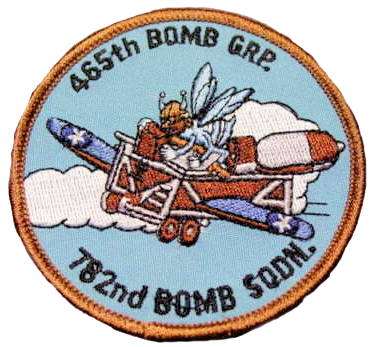 782nd
Bomb Sqdn.
783rd
Pops's outfit
782nd
Bomb Sqdn.
783rd
Pops's outfit
III.
Pantanella
On the twentieth of April 1944, the lead aircraft of the 783rd Bomb Squadron rolled out onto a steel-planked runway in a valley five miles south of the town of Cerignola in southeastern Italy. The runway was still being laid as the crews arrived. The squadron had been kept waiting at Oudna in Tunisia for two months while the U.S. Army Corps of Engineers tried to finish it. The airfield was named for the village nearest to it: Pantanella.
The field sat in the Ofanto River valley. From the cockpit, looking south, the men could see a stretch of farmland that had been bulldozed flat to lay out the runway. Looking north, they could see olive groves on rolling hills where their tents would be pitched. Looking back, in any direction, they could see a piece of ground over which, two thousand one hundred and sixty years earlier, the largest army Rome ever fielded had been annihilated by Hannibal in a single afternoon. The Battle of Cannae took place in this valley. Now, from the same ground, four American bombardment squadrons would launch what one of them later called "another decisive battle" — the long air offensive against Ploesti.
Little could Hannibal have known, as he faced and soon annihilated Consul Gaius Varro in 216 B.C., that one day the Ofanto River valley would be the base from which another decisive battle would be launched. — Maj. Burton C. Andrus Jr., commanding officer, 783rd Bomb Squadron, 1983
Pantanella's two parallel runways were each six thousand feet long and one hundred feet wide. They had been laid with Pierced Steel Planking — interlocking metal panels engineers could put down on raw earth in days — and they made an extraordinary racket when a fully loaded B-24 hit them on landing. A hundred and twenty hardstands flanked them. A steel control tower presided. The 465th shared the field with the 464th Bombardment Group; together they put two hundred-plus B-24s on the ramp.
IV.
Tent City on the Heights
The men called the upper part of the field "Pantanella Heights." Officers in pyramidal tents on one olive-grove hill; enlisted men on the other; mess halls, supply buildings and a dispensary cut from tufa — the volcanic block quarried from local hills, sawn by a Yankee-made cutting blade somebody had welded onto a motorcycle engine. The squadron's photographers worked from a darkroom. Mail came in trucks, daily, and Mail Call was the most important moment of the day; the line went around the supply building.
Every evening at supper a tablet of Atabrine was set beside each plate to ward off the malaria endemic to that part of Italy. Mosquito bars hung in every tent. Vehicles were begged and salvaged and rebuilt: a small captured German tank, several English and German motorcycles, a German jeep, three Harley-Davidsons. Homemade stoves built from cut steel drums and copper gasoline tubing exploded in small ways daily and in larger ways at least once a month. Sergeant Walker woke the crews at half-past two in the morning before each mission and "took the abuse he had to take." The Red Cross Clubmobile girls came around after every return with coffee, doughnuts, lemonade.
The first 783rd man killed in service was a master sergeant the squadron called Pop Green. On the first of April 1944, before they had even reached Italy, Pop Green fell from a cliff at Oran after a night out with the French Foreign Legion. The squadron mourned him for the rest of the war.
V.
The Liberator
They flew B-24s. The Consolidated Aircraft B-24 Liberator — slab-sided, four-engined, ugly to anyone who had seen the elegant B-17, beautiful to the men who flew her because she carried more, farther, with less fuel. She was the workhorse of the Mediterranean. The 465th's aircraft were marked with a black square painted on the upper half of the tail (the 55th Bomb Wing's identifier) and a yellow horizontal stripe across the lower (the 465th's signature). At three thousand miles' range she could put eight thousand pounds of bombs on a target in Romania and come home. Ten men flew her.
The 783rd's original aircraft had names painted on their noses by their crews. Duration Plus. Southern Gal. Moby Dick. Sans Souci. Pith & Moan. Umbriaggo. Section Eight. Shack Queen. Rough and Ready.
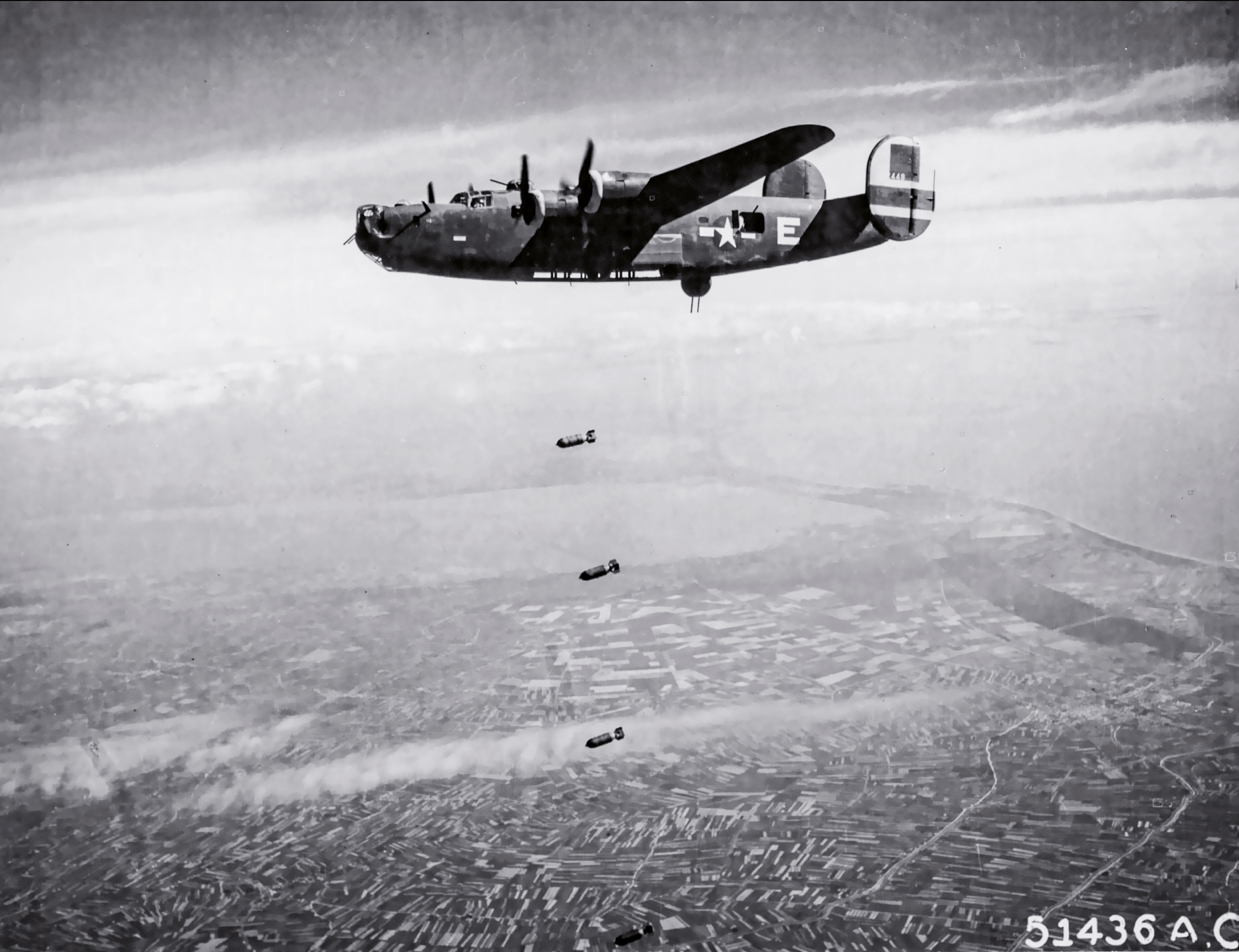
Gum Drop · "Patches" — B-24D, serial 42-52449, of the 783rd Bomb Squadron, photographed over the rail yards at Forlì, Italy, on 19 May 1944 — a month after the squadron arrived in country. (U.S. Air Force / public domain)
VI.
The First Mission & Flak Alley
On the fifth of May 1944, three weeks after landing at Pantanella, the 465th flew its first mission. The target was the German Army headquarters at Podgorica, in occupied Yugoslavia. Eighty-five percent of the bombs landed on target. Ground reports estimated five hundred German soldiers killed. General Twining wired back the next morning: "It was the finest freshman mission ever flown in the 15th Air Force."
Two weeks later, on the eighteenth of May, they hit Ploesti for the first time. Ploesti was the prize. The Romanian oil fields supplied a third of Germany's aviation fuel. They were ringed with seven hundred and twenty antiaircraft guns of eighty-eight millimeter or larger. The 15th Air Force would fly to Ploesti nineteen times that summer. The men called the airspace around it Flak Alley.
| Date · 1944 | Attacking | Tons | Lost |
|---|---|---|---|
| 5 May | 485 | 1,257 | 19 |
| 18 May | 206 | 493 | 14 |
| 6 June | 310 | 698 | 14 |
| 15 July | 607 | 1,526 | 20 |
| 22 July | 495 | 1,334 | 24 |
| 18 August | 377 | 825 | 7 |
| (13 other missions) | 2,999 | 7,336 | 125 |
| 19-mission total | 5,479 | 13,469 | 223 |
T/Sgt. Edward Trauth of the 783rd lost his leg on the eighteenth of May, the squadron's first Ploesti mission and its first combat wounded. The leg was amputated below the knee two days later at the General Hospital in Bari.
VII.
Two Citations
On the eighth of July 1944, the 465th sent its bombers against the Floridsdorf oil refinery and the Vienna marshalling yards. Three weeks later, on the third of August, they hit the Manzell-Dornier aircraft works at Friedrichshafen — a target the Germans had thought beyond range and had not properly defended.
For each of these missions the group was awarded the Distinguished Unit Citation. The first DUC came down formally on the 26th of October 1944; Brigadier General Charles F. Born flew in to Pantanella on the fourth of December to present it, with Colonel Clark — the man who had led the unit on the mission itself — at his side. The second was pinned on by General Twining personally on the first of May 1945, one week before the war in Europe ended.
VIII.
The Cryptographer's Bench
The men who flew were the visible part of the war. The men who stayed on the ground were not — but the squadron could not have flown a single mission without them. Pops's name in the official records was preceded by the designation MOS 805: Cryptographic Technician. The job description ran: "Enciphers and deciphers or encodes and decodes classified messages, using all types of cryptographic systems and equipment employed by the Army. Maintains cryptographic files and manages secret communications." He was required to type twenty-five words per minute. He kept up — his letters home boast more than once about his typing speed.
At the squadron message center he likely worked the M-209: a small mechanical cipher box, three by five by seven inches, six pounds, designed by a Swedish engineer named Boris Hagelin and built by Smith Corona by the hundred-thousand. The M-209 enciphered weather reports, ammunition requests, mission status, and the daily routine paperwork that kept Pantanella running. Higher-priority traffic — operational orders from the 15th Air Force, target assignments, intelligence updates — went through the SIGABA at Wing headquarters in Spinazzola, twenty miles away.
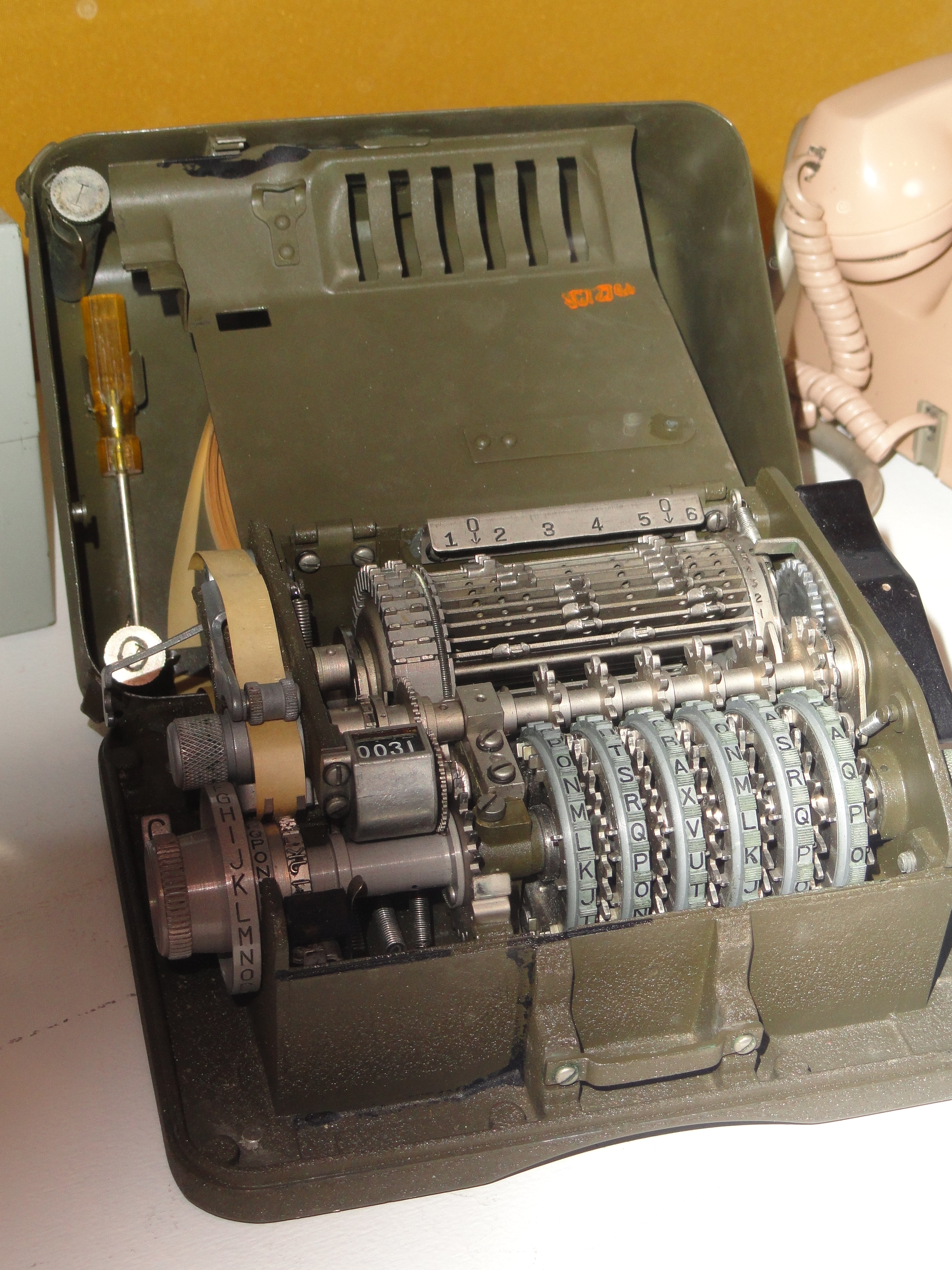
M-209 — what Pops likely worked at his bench. About the size of a small radio; he spun its rotors and read messages off a paper tape. (National Cryptologic Museum / CC0)
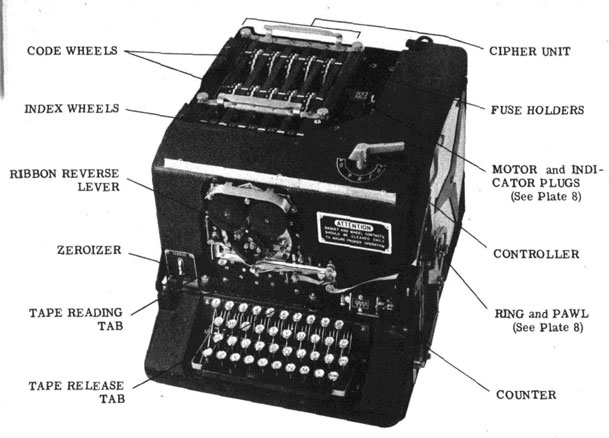
SIGABA / ECM Mark II — the strategic-level machine at Wing HQ in Spinazzola. Too heavy to deploy to a squadron. (U.S. Government / public domain)
IX.
The Outfit Dissolves
The 26th of April 1945 brought the last combat mission of the war for both the 465th Bombardment Group and the 99th — two heavy outfits scattered across the Italian heel, B-24s and B-17s, neither knowing yet that they had flown their last that morning. The 99th's airplanes climbed to altitude over the Po Valley, found their target covered in cloud, and brought their bombs home without releasing. V-E Day, twelve days later, was celebrated at Pantanella with parade and benediction and surplus alcohol; it was celebrated at Tortorella, forty miles down the Tavoliere plain, in much the same way.
Then the war's machinery began coming apart. By the 26th of May the 783rd was in trucks for Naples. The squadron sailed for Port of Spain, Trinidad, on the 6th of June — without Pops. He was in a military hospital in Bari, recovering from a malarial bout in the same recurring series that had begun at Monte Cassino fifteen months earlier. Ten days in a ward, then a replacement depot, then orders to a new outfit. When his fever broke, the war was over and his squadron was on the South Atlantic.
The 99th Bombardment Group had been at Tortorella since the 11th of December 1943 — eighteen months on the ground at the same airfield before Pops set foot on it. It was a B-17 outfit, not a B-24; the elegant Flying Fortress in place of the slab-sided Liberator. The men called themselves the Diamondbacks, from the diamond painted on the vertical stabilizer. The group had won two Distinguished Unit Citations of its own — Gerbini airfield in Sicily, July 1943, and the Wiener Neustadt aircraft factory in Austria, April 1944 — both earned by the 347th, the squadron Pops was now in, by men he had never trained with. He kept the new unit patches, but they were never his patches the way the 783rd's had been.
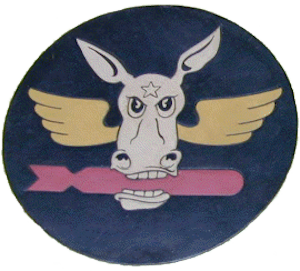
347th Bomb Squadron emblem — approved 18 February 1944. A green camera aperture and red lightning bolt crossed in saltire; a futuramic aircraft above a light-blue globe. The squadron earned both of the 99th BG's Distinguished Unit Citations — Gerbini, Sicily, July 1943, and Wiener Neustadt, Austria, April 1944. Pops joined eleven months after the second. (U.S. Air Force / public domain)
The squadron mailed for him. The C.O. signed his paperwork. The paymaster put his name on the roster.
Officially, he was theirs. In the letters, he never quite says so.
X.
The Last Italian Summer
The summer of 1945 was the slowest summer of Pops's life. He spent it at Tortorella, in a tent through May and June, then in a house. He played pinochle and ping-pong; he developed photographs from his February rest-camp trip to Rome; he ran the message center for a B-17 group that was no longer at war and not yet on its way home.
By July the wartime censorship had been abolished, and for the first time in the corpus Pops could write home about what he actually did. From his September 4th letter: "battle orders, which came in code … encoding and preparing … Intelligence annexes, mission reports, weather and stuff like that. Also did plenty of teletype work, some radio, editor board, flimsys, and reports." He was a Cryptographic Technician — MOS 805 — "just below the top" in the cryptographic hierarchy, second only to the Cryptanalyst, by his own July 20th accounting. His chief was a 21-year-old former navigator with flak wounds in one leg, taking an Art course in Rome. The war's last enlisted men were like that.
And then, in those slow months, Pops did something the 2010 thesis did not know about. With Group Headquarters' encouragement he filed a formal request for Army transport north — first to Warsaw, to find his mother's sister Helen and her family on Krochmalna Street, with whom the last contact had been in 1939 or early 1940. The answer came back that the Russian zone made it impossible. He filed again, this time for Vienna, where his father's brother and sister had lived since the Anschluss made them German. Denied. He resubmitted at Wing Headquarters' suggestion. "Travel into Austria is not authorized," came the final decision in late August. Three formal requests; three denials. He saved the request-letter copies from being thrown out. They may still exist in his papers.
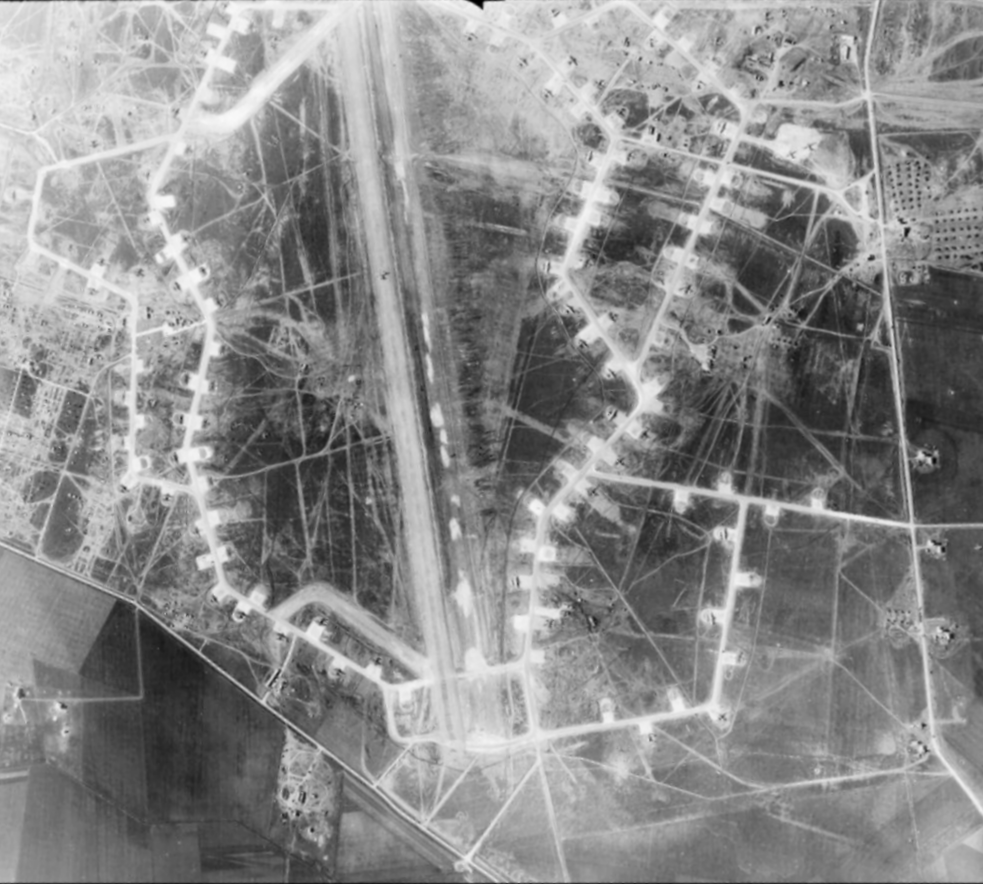
Tortorella Airfield, photographed from above on the 27th of February 1945 — about ten weeks before Pops arrived. A single asphalt-over-PSP runway, 6,700 feet, oriented 16/34. Aircraft maintenance was done in the open; personnel were tented. The base was shared with RAF 231 Wing (37 and 70 Squadrons), flying Wellingtons, Liberators, Stirlings, and Lancasters from the same field — an uncommon US-British co-tenancy. (Air Force Historical Research Agency / public domain)
He shipped out the second week of September. The 15th Air Force itself was officially inactivated in Italy on the 15th of September 1945. The 99th Bombardment Group would not deactivate until the 8th of November — the last B-17 group in the Mediterranean to fold — but by then Pops was home.
XI.
After
The 465th's last combat mission flew on the twenty-sixth of April 1945. V-E Day was celebrated at Pantanella on the eighth of May. By the twenty-sixth of May the squadron was in trucks for Naples. They boarded the U.S.S. Admiral Edward Eberle on the sixth of June and crossed the Atlantic to Port of Spain, Trinidad, where the Air Transport Command was running the Green Project — flying troops home from Europe via the South Atlantic. On the 31st of July 1945, the 465th Bombardment Group and the 783rd Bomb Squadron were officially inactivated.
Pops sailed home in September. He took his typewriter, his photographs, his three-hundred-plus letters from Pop and Mom and Anna, and the few souvenirs that survived. He went back to Quaker Lane.
In September of 1983 the surviving men of the 783rd held a reunion at the United States Air Force Academy in Colorado Springs. They dedicated a memorial plaque in the Academy cemetery, on Parade Loop west of Stadium Boulevard:
To those brave and dedicated members of the 783rd Bomb Squadron (Heavy) of the 465th Bomb Group, 15th Air Force, who flew their final mission against the enemy from Pantanella Air Base, Italy, during World War II. — 783rd Bomb Squadron Memorial, USAFA Cemetery, dedicated 23 September 1983
Major Burton C. Andrus Jr. — the squadron's first commanding officer — flew back to Italy the year before. He wrote afterwards: "There is absolutely no sign of the war. The valley is fully restored to its original state — olive groves and vineyards flourish."
From the same ground, in 216 B.C., Hannibal had withdrawn after Cannae.
After two thousand one hundred and sixty-one years, this war too withdrew.
End of the Interlude
Part Two
The Letters
in His Own Hand
Three hundred letters, written between July 1943 and September 1945. Typed here for ease of reading; preserved here against forgetting. — A Note on the Transcriptions
783rd Bomb. Sqd. (H)
465th Bomb. Gp. A.A.B.
McCook, Nebraska.
January 25, 1944.
Dear Anne,
Say what goes on anyway? When you wrote your last letter we were already living 16 days in the new year, but you didn't seem to realize the difference, because you still addressed it as 1943. What bothers me is that I did the same thing several times already myself. Karl called my attention to it and so did Connie. Is it Spring, love, fever, leap year, or just ordinary carelessness?
Well I guess things have quieted down by now at home in regards to "Blessed Events". I'm glad to hear Kathleen and baby as well as Lucille and Dennis are fine. I'm also a little puffed up over the fact that my latest nephew is named after me.
I can realize what you have to put up with in Little Kathleen and Johnny, because I can remember when they weren't angels before.
Love,
Art.
Part Three
Behind the Book
How three hundred letters became this volume — the scanning, the transcription, the choices made along the way, and a note on the companion audio. — A Methodology
Behind the Book
A Note on Method
The letters in Part Two were transcribed from photographs of the originals, taken across 2026. Where the handwriting resisted reading — ink that had bled, paper that had thinned, a name half-erased by sixty years in a cardboard box — the transcription notes a [?] in place of the missing word. Nothing has been silently corrected.
What follows is a brief account of how this volume was made: how the letters were scanned and transcribed, how the audio companion was produced, what I leaned on, and who deserves the thanks.
Behind the Book
Scanning & Transcribing
the Letters
The corpus
Roughly three hundred letters survive, written between July 1943 and September 1945. They had spent six decades in a cardboard box in my grandfather's own attic — carried home from Italy and never thrown away — sorted into rubber-banded bundles with hand-written date tags (August Sept Oct 1944) and a folded copy of the Polish-language newspaper Dziennik tucked among them. Most are addressed to Pops's older sister Anne or to his father, John Sr.; a handful went to other siblings, cousins, and friends. About half are handwritten and about half were typed at his cryptography desk, on Army Air Forces stationery.
Photographing the originals
Each letter was photographed with an iPhone, flattened beneath a stack of books and shot in portrait orientation under indirect daylight. Envelopes were photographed alongside their contents whenever they survived; the postmarks have proved, more than once, to be the only reliable way to date letters that Pops himself did not.
Transcribing the cursive
A first-pass transcription was prepared by feeding each scan to
Anthropic's Claude, which produced a draft with [?] markers
wherever it could not commit to a word. I then read every page against
the original, replacing those markers where I could and leaving them
where the word is genuinely lost. Every letter has a row in
letter-index.csv — date, recipient, location,
confidence, file path. It is the spine of the book.
Behind the Book
The Companion Audio
& the Voice Clone
The plan
An audio version of Part One exists. I narrate the connective tissue, and an AI-generated rendering of Pops's voice reads his own letters aloud. The voice was cloned with the explicit, written consent of his only surviving child — my mother — and is intended for private family use only.
Source material
Pops died in 2001, so no recordings of him as a young soldier exist. What survives is family video footage from the 1960s through the 1990s — handycam tape of him at home, in the yard, on the porch, telling small stories nobody thought to preserve. From those tapes I pulled four passages: a long stretch of him talking through tree-cutting in the 1990s, a July 4th gathering from 1985, an evening on Sue's apartment porch from the same summer, and the first time he held a new video camera in 1986. About thirty-two minutes of audio in all.
Cleaning the audio
Each clip moved through three stages. The raw download stayed untouched; an intermediate folder held a lossless trim, a WAV conversion, and the output of Adobe Podcast Enhance, which removed room noise without bleaching the voice. A final folder held the finished MP3s, mono and small enough to feed the cloning service. Where another voice crossed Pops's mid-sentence, I removed the second speaker by hand, guided by machine-generated transcripts.
The voice clone
The thirty-two minutes were submitted to ElevenLabs as a Professional Voice Clone. Their default policy reserves the service for a person's own voice; for a deceased relative, they require a manual review. I submitted my mother's signed posthumous-consent form, my grandfather's death certificate, supporting photographs, and a written description of the project — non-commercial, family-only, an audiobook of his own letters. The review came back approved within a day.
Generation
Once the voice was trained, generating audio for a chapter became a matter of feeding the chapter's text in and reviewing the result. Some takes are more him than others; a particular intonation drifts here, a vowel sits flat there. For the lines that mattered most, I generated the same passage several times and chose the take that sounded the most like him.
A second path, kept open
A self-hosted backup using the open-source XTTS-v2 model was built and tested against the same source material, in case the commercial path had ever needed to be abandoned. It works — well enough that, if the rights conversation ever shifts, the family will not lose the voice.
Behind the Book
Sources &
Acknowledgments
Primary sources
The letters themselves are the spine of this book. Where I have quoted them, the spelling, punctuation, and grammar are Pops's own.
Secondary sources
Most of the historical scaffolding comes from my own undergraduate thesis, An Analysis of WWII Letters as sent by Cpl. Arthur Yena (Lataille, 2010), which drew on a smaller subset of these same letters. For unit history I have leaned on Floyd E. Gregory's History of the 783rd Bomb Squadron and 465th Bombardment Group (1989). For the wider picture of the 15th Air Force in Italy, the standard works listed in the bibliography of the 2010 thesis remain the best entry points.
Acknowledgments
To my mother — the only living link to most of what is in these pages, who said yes when I asked whether I could clone her father's voice, and whose memory has filled in the spaces between the letters — thank you. To Dr. David Plazek and Dr. Alexander Strokanov of Lyndon State College, who advised the thesis from which this book grew: this is the version that one was reaching for.
And to Pops himself, who wrote three hundred letters home in three years, who carried every one of them back across an ocean and kept them in his attic for the rest of his life, and who built the quiet life that made everything that follows possible: I never met you. I think of you often.